Yakushi-ji: the temple born of a vow to heal an empress
In 680 an emperor vows to build a temple. Thirteen centuries later, a pagoda from 730 still stands in Nara.
The most famous temple dedicated to Yakushi Nyorai, in Nara, began with a very human act of devotion: a man praying for his sick wife.
The emperor’s vow
According to tradition, in 680 Emperor Tenmu vowed to build a temple for the recovery of his wife, the future Empress Jitō, who was seriously ill. He died before the work was finished (686); Jitō continued it, and the temple was completed under Emperor Monmu. It originally stood at Fujiwara-kyō, the old capital. In 718, when the capital became Heijō-kyō (Nara), the temple was moved to its present site.
A pagoda of “frozen music”
The East Pagoda (Tōtō), dating from 730, is the only original building of the temple to survive. It has three storeys but seems to have six, because each level has a small intermediate roof (mokoshi). This alternation of large and small roofs gives the pagoda a light silhouette. It is reported that the American Ernest Fenollosa, in the 19th century, described it as “frozen music”: the phrase is famous, but its exact attribution is uncertain.
The bronze triad
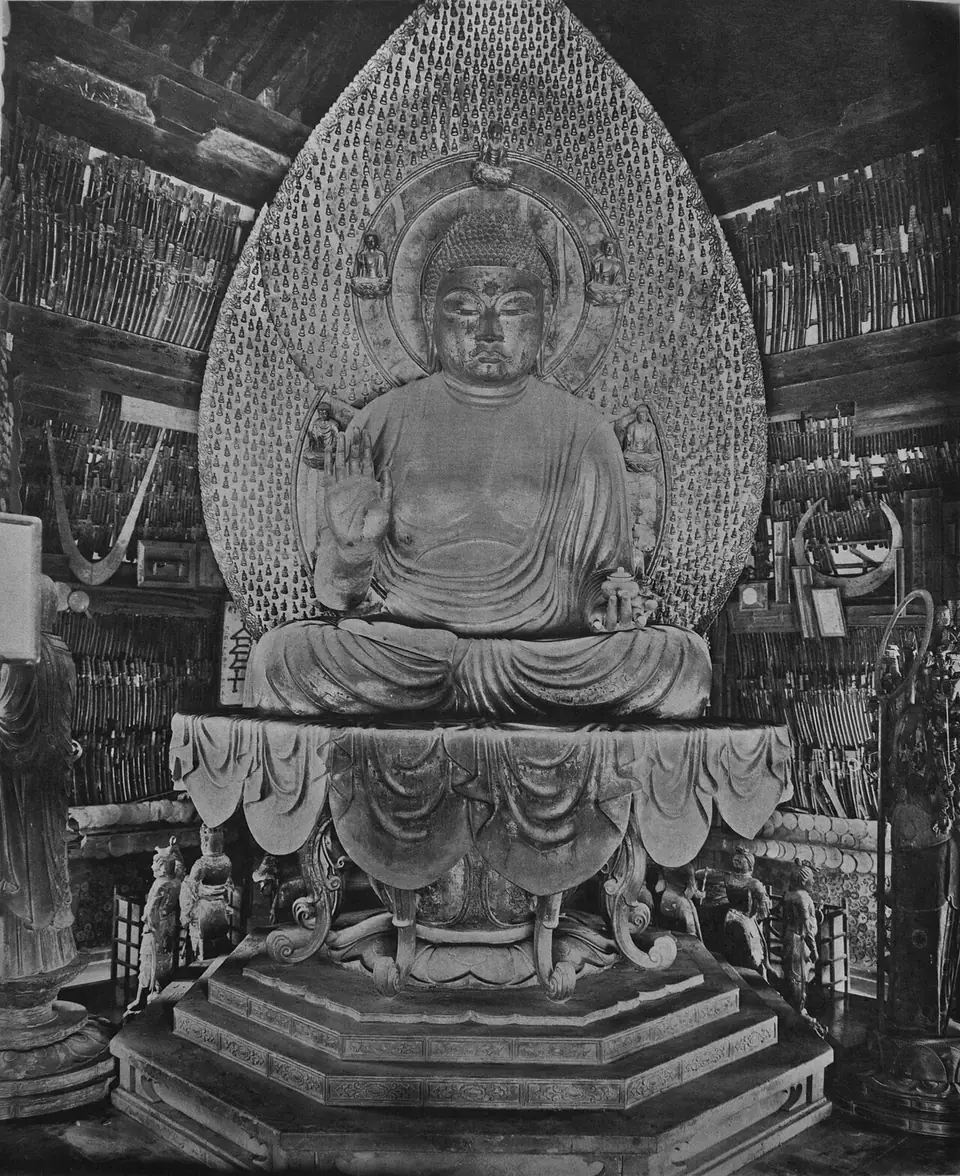
The golden hall (Kondō) houses the triad of Yakushi Nyorai, flanked by Nikkō and Gakkō, in dark bronze, a national treasure. The pedestal is famous: arabesque vines, motifs inspired by Persia, and figures recalling the art of Central Asia. It has been discussed as an example of the Silk Road reaching Nara.
Trials and rebirths
The buildings suffered fires and wars. A fire in 1528 destroyed much of the original buildings. The present golden hall dates from 1976, the West Pagoda from 1981, and other buildings followed: the whole is a work of patience by 20th-century monks and craftsmen, using the original techniques. The temple belongs to the “Historic Monuments of Ancient Nara”, inscribed on the UNESCO World Heritage List in 1998.
Xuanzang and Yakushi-ji
The temple is tied to the Hossō school, heir to the teaching of Xuanzang, the same monk whose translation of the sūtra is the most read. A sanctuary of the temple, the Genjō Sanzō-in, is dedicated to him, and the painter Hirayama Ikuo made a large mural there on his journey west. The circle is thus closed: a monk translates the text in the 7th century, and a temple founded in Nara for the same Buddha keeps his memory.
Today
Yakushi-ji can be visited all year; hours and fees are on its official website. It offers sūtra copying (shakyō), pilgrimage seals (goshuin) and seasonal events. For the pilgrimage in western Japan, see the Yakushi temples of Japan.
Sources
Official site of Yakushi-ji; UNESCO, Historic Monuments of Ancient Nara (1998); Japanese Agency for Cultural Affairs, national treasure records. Founding dates are those of the temple’s tradition.
Read the articleYakushi temples in Japan: Nara, Kyoto, Mount Hiei