The eight Medicine Buddhas: seven brothers and a master
Why thangkas show eight Buddhas, who the other seven are and how they are invoked.
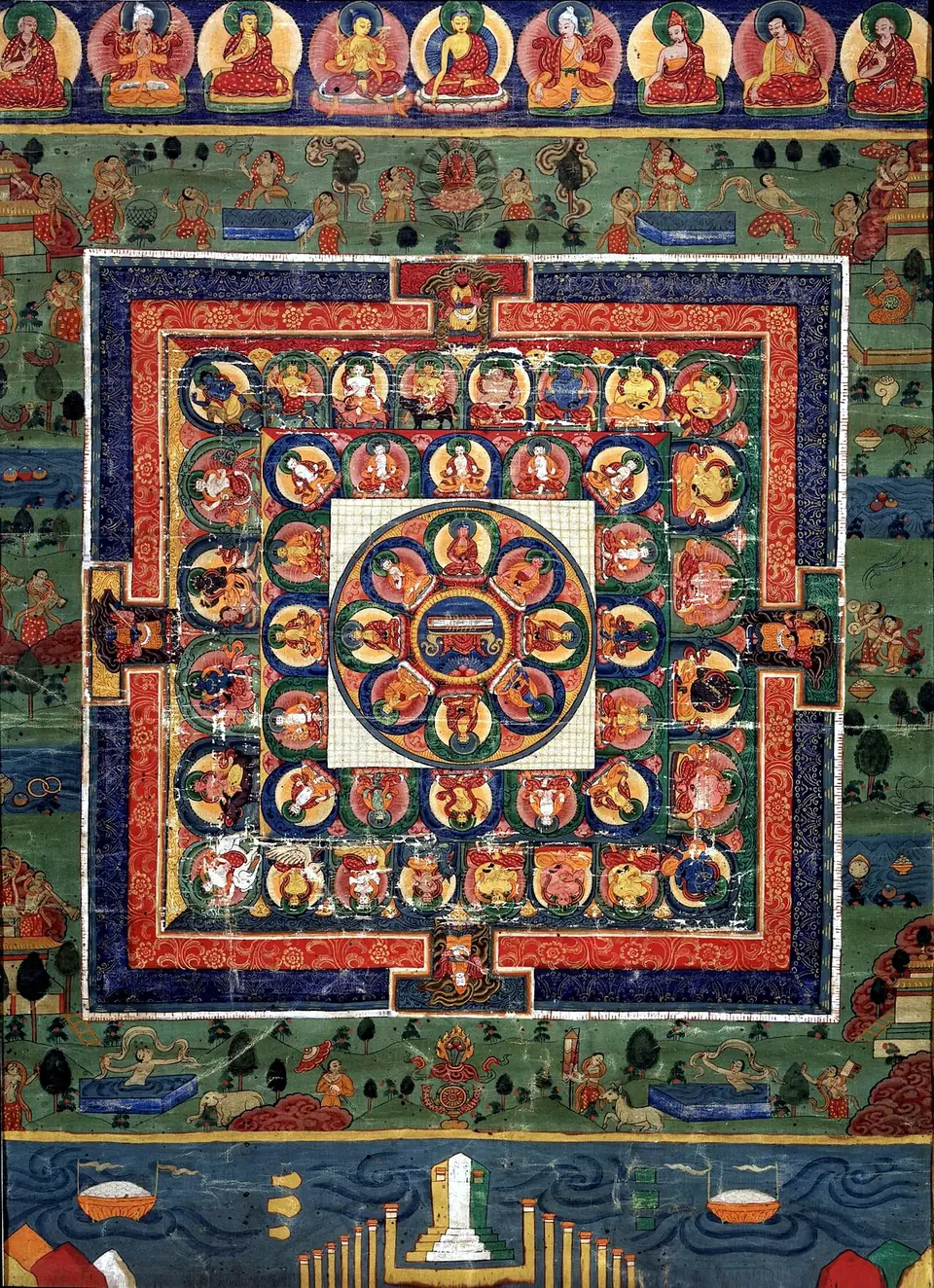
In most Tibetan monasteries the Medicine Buddha shrine holds not one but eight Buddhas: a great blue Buddha at the centre and seven others around him. This group comes from one version of the sūtra.
Seven in Yijing’s text
The version translated by Yijing in 707 speaks not of one but of seven Medicine Buddhas. Each Buddha has a name, a pure land and vows of his own. Bhaiṣajyaguru, the best known, is the seventh of the series. In Tibet, the reading of the text produced a group of eight: the historical Buddha Śākyamuni is often added as the eighth, or Bhaiṣajyaguru is placed at the centre with his seven companions around him.
The names
According to the list of this tradition, the seven Buddhas bear the following names (in Sanskrit; spellings vary by edition and translation):
- Suparikīrtitanāmaśrī (“of perfectly glorious name”),
- Svaraghoṣarāja (“king of the melodious voice”),
- Suvarṇabhadravimalaratna (“pure jewel, good as gold”),
- Aśokottamaśrī (“supreme glory without sorrow”),
- Dharmakīrtisāgaraghoṣa (“voice of the ocean of the glory of the Dharma”),
- Abhijñārāja (“king of higher knowledges”),
- Bhaiṣajyaguru-vaiḍūrya-prabhā-rāja (“king of lapis lazuli light, master of remedies”).
The Tibetan, Mongolian, Chinese and Japanese names differ and are often longer. If you buy a thangka, it can help to ask which list the painting follows.
How to recognise them in a painting
In Tibet they are often painted in the same posture, seated on a lotus throne, hands in the gesture of giving or meditation. What distinguishes them are their colours and attributes, which vary by list and workshop; Sangye Menla is always recognisable by his blue. In some compositions the eight are arranged in a circle around him.
The eight in practice
In several Tibetan monasteries the names of the Medicine Buddhas are recited in collective ceremonies. In Japan one speaks of the “Shichibutsu Yakushi”, the seven Yakushi. These practices are acts of memory and devotion, not medical promises.
Where to see them
See the thangkas in the catalogue, and the guide to choosing a thangka.
Sources
Sūtra of the Seven Medicine Buddhas (Yijing’s translation, Taishō 451); Raoul Birnbaum, The Healing Buddha (1979). Names and their order vary by source.
Read the articleThe Medicine Buddha mantra: text, meaning and use