Practising the Medicine Buddha at home: a simple outline
From refuge to dedication: what practitioners do, with a mala and ten quiet minutes, promising nothing more than attention.
There is no single way to practise. The Tibetan, Chinese and Japanese traditions each have their rites, and the best way to begin is with a teacher (see Services & places). Here, out of curiosity, is the usual structure of a short session.
1. Preparing
One sits, back straight. Many place an image of the Buddha at eye level, a glass of clear water as an offering, and a candle. The article on the altar gives ideas for setting it up.
2. Refuge and intention
One recalls that one turns to the Buddha, his teaching and the community, and one forms the intention to practise for the good of all beings. In this view it is not only a practice for oneself.
3. Visualisation
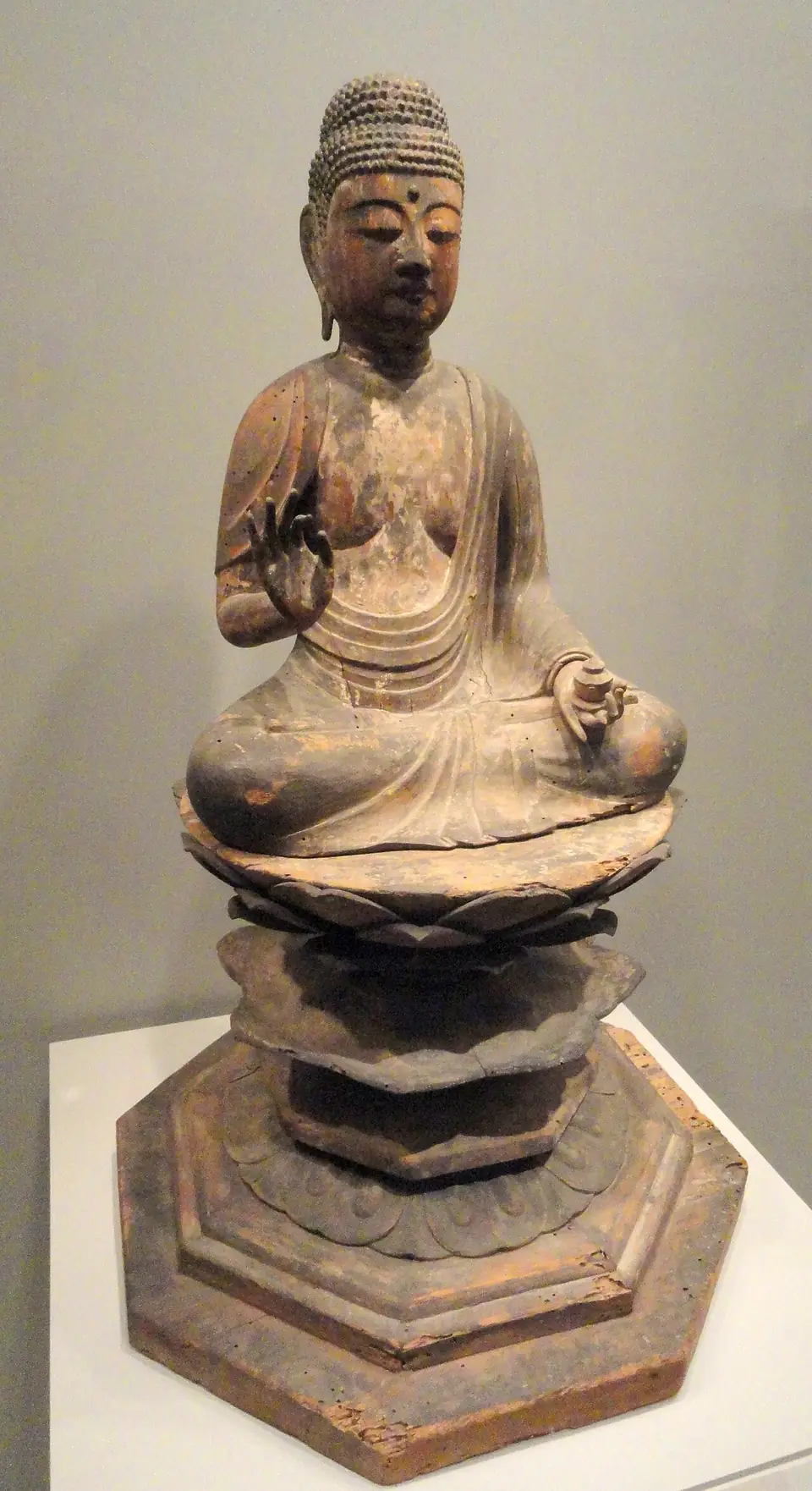
The practitioner imagines, above the head or in front, Bhaiṣajyaguru seated on a lotus and a moon disc. His body is lapis blue and radiates light. In the left hand, a bowl of nectar; in the right, the myrobalan branch. Blue light fills the practitioner’s body and mind, and extends to others. It is an exercise in concentration, and tradition describes visualisation as a way of recognising the Buddha’s qualities in oneself.
4. Recitation
The mantra is recited, most often with a 108-bead mala (or 21, or 27), counting. The text of the mantra and its meaning are in the dedicated article. In China, Japan and Vietnam, the Buddha’s name or passages of the sūtra are also recited.
5. Dedication
The session ends with dedication: one offers whatever good has been done to all beings. It is a traditional gesture, present in almost all Buddhist rites.
The rites described in the sūtra
In Xuanzang’s version, the sūtra mentions collective rites: reciting the text, lighting lamps (the text speaks of forty-nine), hanging banners of five colours, offering food to the community, freeing captive animals. These gestures are described as occasions to practise generosity. In the teachers’ spirit, the rite is not a contract: it replaces neither medical care nor the advice of a health professional.
For whom?
For those whom the image of the blue Buddha touches, whether through faith, art or simple curiosity. If you are ill, consult a doctor first; the practice may accompany, it replaces nothing. You will find music and mantras recorded by monks and artists in the section of that name.
Sources
Medicine Buddha Sūtra (Xuanzang, Taishō 450); Tibetan usages as described in common sādhanas; Raoul Birnbaum, The Healing Buddha (1979). Details vary by lineage: follow your teacher’s instructions.
Read the articleSymbols and legends: the bowl, the myrobalan, the sun, the moon and the twelve generals