Symbols and legends: the bowl, the myrobalan, the sun, the moon and the twelve generals
Every detail of a Medicine Buddha image tells something. A small decoder of the symbols.
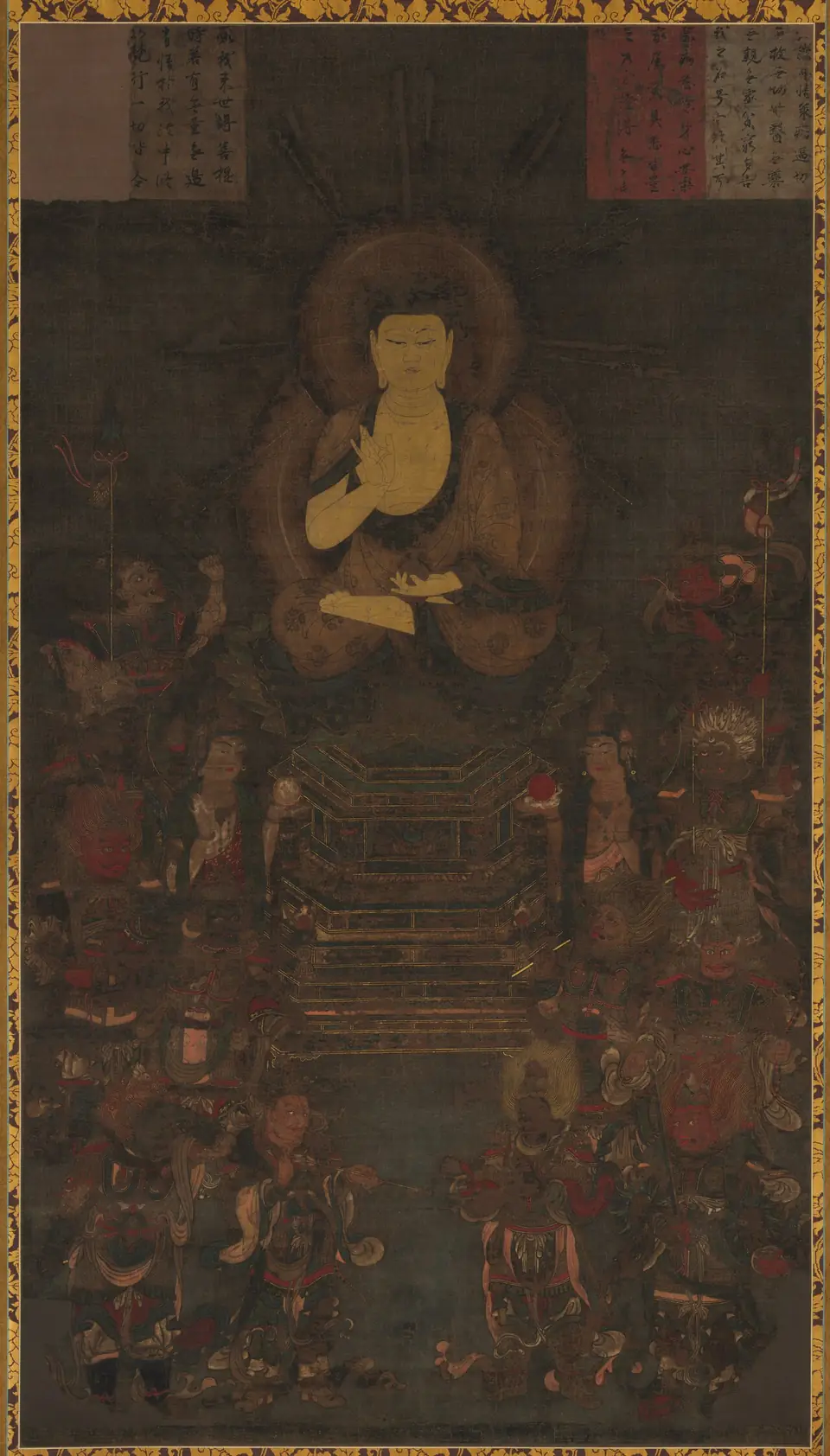
An image of the Medicine Buddha is a coded message, which the faithful read like a page. Here are the main elements.
The bowl of nectar
In the left hand, a bowl (or, in Japan, an ointment jar). For some it is the monk’s alms bowl, a symbol of simplicity; for others the nectar of immortality (amṛta), which stands for the wisdom that soothes. In thangkas it is often blue, like the Buddha’s body.
The myrobalan (arura)
The myrobalan branch held in his right hand is a real fruit: Terminalia chebula, widely used in Indian (Ayurveda) and Tibetan medicine. The texts call it “king of medicines”. Tradition says the Buddha holds out a branch to those who call on him, the image of giving.
The sun and the moon
Two bodhisattvas, Sūryaprabha (Nikkō) and Candraprabha (Gakkō), often escort him. They symbolise the light of day and of night, clarity and gentleness: those who suffer by day and by night are accompanied. In Japanese triads they are two slender figures flanking a seated Yakushi.
The twelve heavenly generals
According to the sūtra (Xuanzang’s version), twelve great yakṣa generals, each with 7,000 attendants, vow to protect those who honour the Buddha. The Sanskrit names vary; in Japan they are known as Kubira, Basara, Meikira, Antira, Anira, Sandira, Indara, Haira, Makora, Shindara, Shōtora and Bikara. In Japan they were matched with the twelve zodiac animals and the twelve hours. The twelve clay generals of Shin-Yakushi-ji in Nara, from the 8th century, are a masterpiece of the genre.
The lotus and the moon
The Buddha sits on a lotus and a moon disc, symbols of purity and clarity of mind.
The blue
See the article on lapis lazuli: the blue is not decorative, it evokes transparency and depth.
The lamp of Mount Hiei
A Japanese legend says that Saichō, founder of Enryaku-ji, lit a flame before the temple’s Yakushi that never ceased to burn. When Oda Nobunaga destroyed the temple in 1571, the flame is said to have been kept in another temple, Risshaku-ji in Yamagata, which later returned it. It is an oral tradition, which must be presented as such.
An iconographic anecdote
In Japan, the oldest Yakushi, such as those of the 7th century, generally have no medicine jar in the hand: this attribute spreads later, from the Heian period, according to art historians.
Sources
Medicine Buddha Sūtra (Xuanzang, Taishō 450); Shin-Yakushi-ji records; Raoul Birnbaum, The Healing Buddha (1979). Legends are presented as such and are not established facts.
Read the articleThe Medicine Buddha thangka: how a sacred blue is painted