The Eastern pure land: Vaiḍūryanirbhāsa, the land of lapis lazuli light
Beyond worlds as many as the grains of sand in the Ganges: a land whose ground is a blue stone, and which, says the sūtra, can be reached in thought.
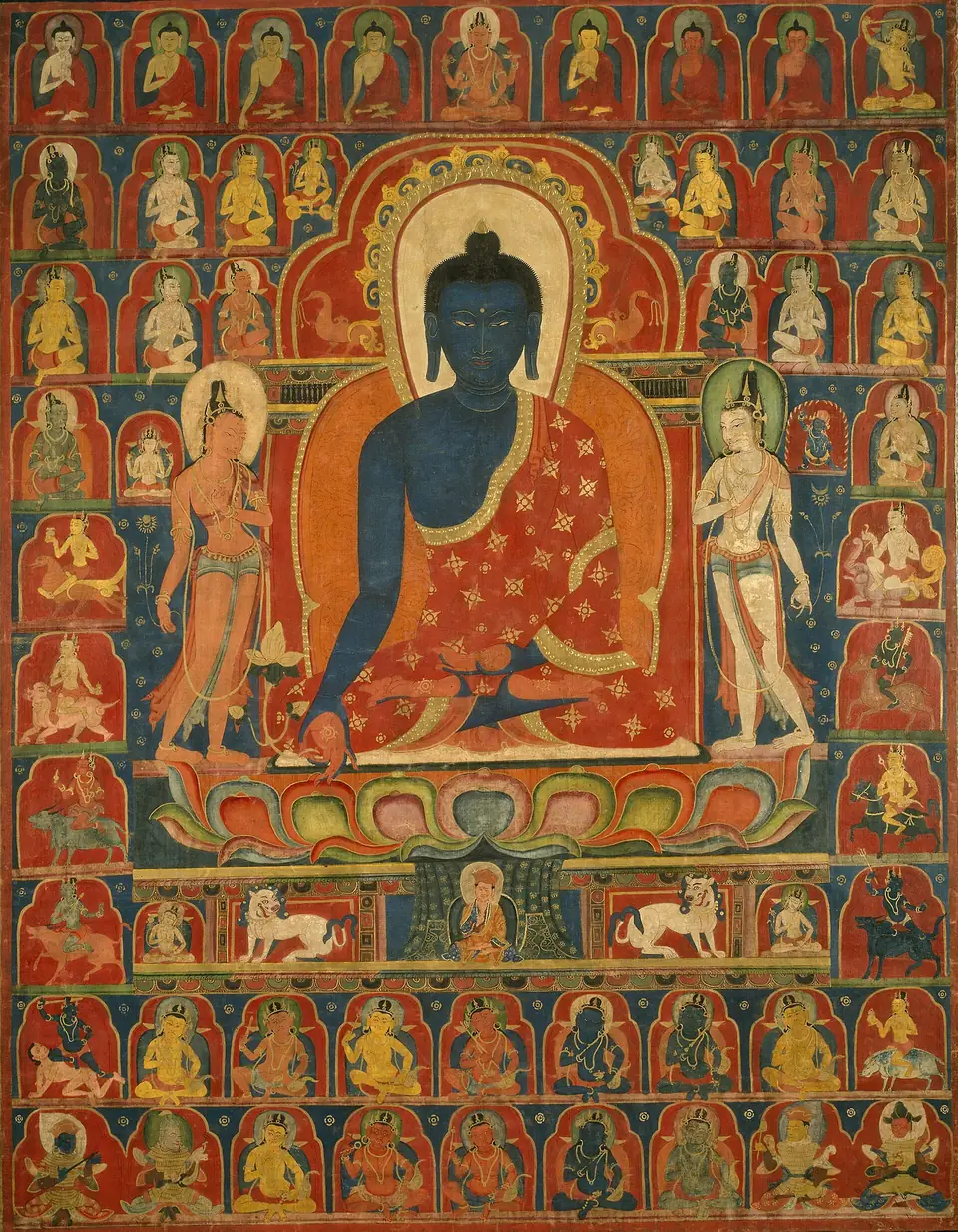
Many people know the Western Pure Land, that of the Buddha Amitābha. Fewer know its eastern sister, where Bhaiṣajyaguru reigns: Vaiḍūryanirbhāsa, “Pure Lapis Lazuli Light”.
Where is it?
According to the sūtra, it lies to the East, beyond ten times as many Buddha-lands as there are grains of sand in the Ganges. This is not a distance in kilometres but an image: a land so far away that it can be reached only by thought and merit.
What does it look like?
The ground is lapis lazuli; golden cords mark out the paths. The walls, towers, palaces and gateways are made of the seven jewels. According to the text, it has the same beauty as Amitābha’s land in the west. The text describes it without bad destinies and without suffering. Two bodhisattvas stand beside him: Sūryaprabha (Nikkō, “sunlight”) and Candraprabha (Gakkō, “moonlight”). They lead the multitude of bodhisattvas of this land.
Being reborn there, or just thinking of it
One idea of the sūtra is important: the possibility of rebirth in this pure land, as in that of Amitābha. The sūtra also says that those who, as death approaches, have heard the name of Bhaiṣajyaguru are guided by eight bodhisattvas to this land. It is a consolation for the dying as much as a hope for the living.
A paradise on the walls: the caves of Dunhuang
The theme was painted at Dunhuang, at the edge of the Gobi desert, in the Mogao caves, where murals of the Tang period and later represent the pure land of Bhaiṣajyaguru: a Buddha on a throne, surrounded by bodhisattvas and buildings with curved roofs, with the scene of the twelve vows and the “nine untimely deaths”. These paintings are today major witnesses of the Buddhist art of Central Asia.
A blue world in Japan
Japanese painters represented this bluish land on scrolls and on the bases of statues. The golden hall of Yakushi-ji, in Nara, has a pedestal of extraordinary richness, with vine arabesques and figures from the Silk Road: a piece of Central Asia on the island of the Rising Sun. See Yakushi-ji.
What does “pure land” mean?
In the Mahāyāna, a pure land is the field of action of a Buddha: a space formed by his vows and merit, where it is easier to practise. Many teachers understand it both as a distant place and as the state of mind of the practitioner. This is why one can also say that lapis lazuli, in the sūtra, is above all a language of clarity.
Sources
Medicine Buddha Sūtra (Xuanzang, Taishō 450); Raoul Birnbaum, The Healing Buddha (1979); Dunhuang Academy (Mogao caves). Exact depictions vary by cave and period.
Read the articleLapis lazuli, the colour of the Medicine Buddha