The twelve vows of the Medicine Buddha, one by one
Twelve promises made before Awakening: light, wisdom, justice, food, clothing… The vows as presented in Xuanzang’s translation.
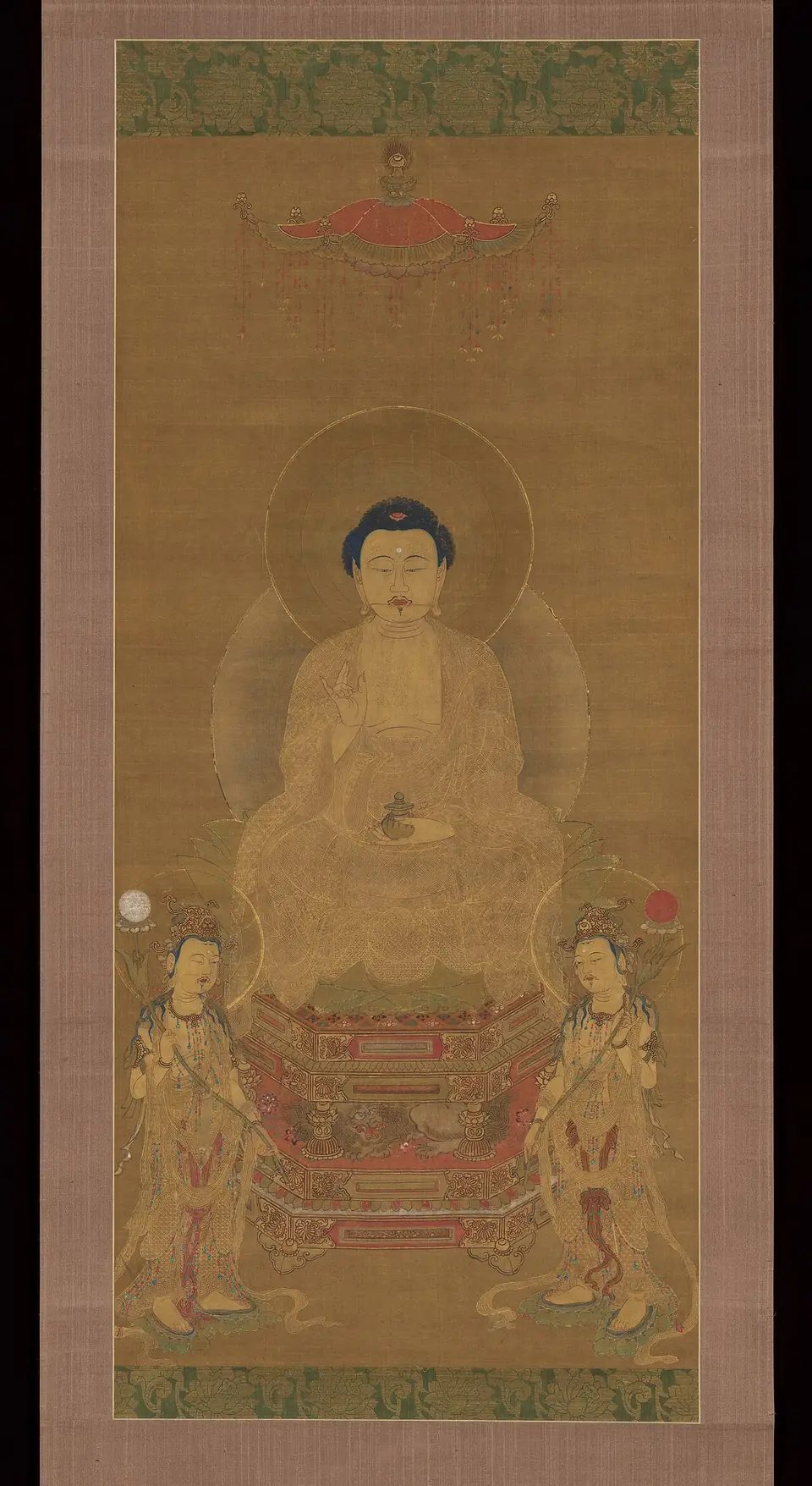
The vows are the heart of the sūtra. Before becoming a Buddha, Bhaiṣajyaguru was a bodhisattva who made twelve promises before an ancient Buddha. Each vow begins “When I attain Awakening…” and describes a world in which a particular suffering would have disappeared. Here is each of them, in a faithful paraphrase of Xuanzang’s translation (650). A reminder: these are religious aspirations, written in India more than fifteen centuries ago, not promises of medical results.
1. A light that illuminates everything
May my body shine and light up countless worlds, and may all beings be adorned with the marks of a Buddha. This is the vow of light.
2. A transparent body
May my body be pure as lapis lazuli, transparent within and without, and may this light dispel the darkness of beings. This is the blue colour, explained.
3. That nothing be lacking
May I, through wisdom and infinite means, fulfil the needs of all beings, so that none lacks what is necessary.
4. Towards the right path
May those who follow mistaken paths find the way to Awakening, and may those who travel in the vehicles of listeners or solitary buddhas be established in the Great Vehicle.
5. Pure conduct
May those who have received precepts and broken them be able to regain purity and not fall into bad destinies when they hear my name.
6. A whole body
May those whose bodies are marked by ugliness, blindness, deafness, infirmity or incurable illness be endowed with complete faculties on hearing my name. The text here states a spiritual wish for wholeness, in a time when disability meant social exclusion; tradition does not read it as a promise of medical treatment.
7. A refuge for those who have none
May those afflicted by illness, without support, doctor, home or resources, be relieved on hearing my name, until they attain Awakening.
8. Freedom from the female condition
May women overwhelmed by the sufferings of their condition, and wishing to be freed from it, be liberated. The text reflects an ancient world and its ideas; each tradition interprets it in its own way, and contemporary teachers offer broader readings.
9. Freedom from Māra’s nets
May all beings be delivered from the nets of Māra and the bonds of mistaken doctrines, and established in right view.
10. Freedom from prisons
May those who are chained, condemned or threatened by the king be freed from fear and sorrow, by the power of my merit.
11. Food for the hungry
May those suffering from hunger be first fed, then nourished by the taste of the Dharma.
12. Clothing for the cold
May those who are poor, naked, tormented by cold, mosquitoes and heat receive precious clothes, ornaments, flowers, music and cause for joy.
An overall reading
It is striking how the twelve vows alternate the material and the spiritual: hunger sits beside wisdom, clothing beside precepts. Vows 1 to 2 speak of the Buddha’s light, vows 3 to 5 of the path, vows 6 to 8 of the body and the human condition, vow 9 of freedom of thought, 10 of justice, vows 11 and 12 of basic needs. This last series gave the cult its very concrete character, and inspired institutions of mutual aid in Buddhist Asia. In ancient Japan each vow was associated with one of the twelve heavenly generals (see symbols and legends).
Sources
Medicine Buddha Sūtra, Xuanzang’s translation (Taishō 450); Raoul Birnbaum, The Healing Buddha (1979). The versions of Dharmagupta, Xuanzang and Yijing differ slightly in detail.
Read the articleThe Eastern pure land: Vaiḍūryanirbhāsa, the land of lapis lazuli light