Where to see the Medicine Buddha in museums around the world
Chicago, New York, Cleveland, Stuttgart, Saint Petersburg, Chengdu: a short tour of the works reproduced on this site, and where to find them.
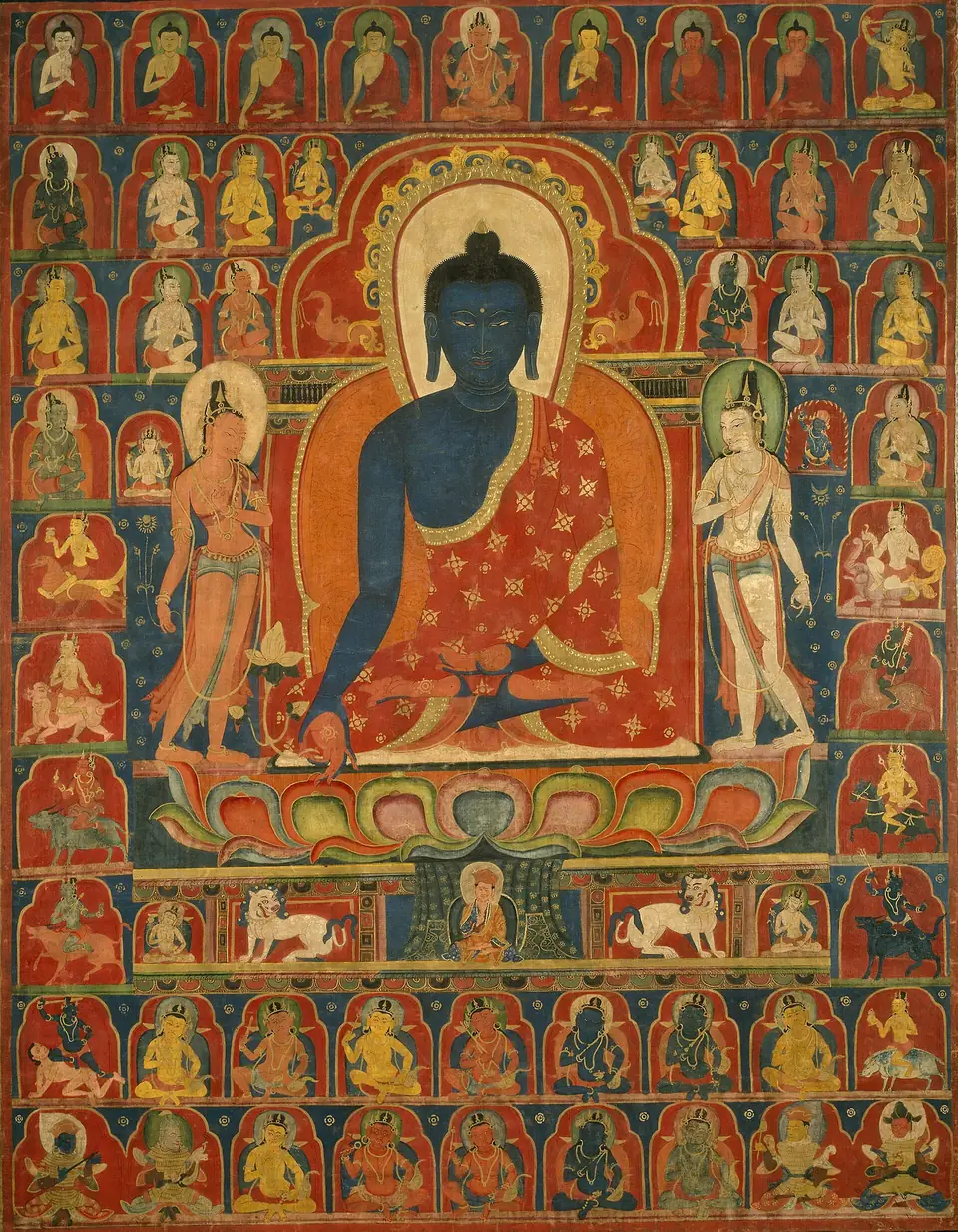
The images illustrating this site all come from museums or temples that have published copyright-free reproductions. Here is where they are, and what they tell.
Art Institute of Chicago
A Tibetan painted banner (thangka) of the thirteenth to fourteenth century, and a Japanese wooden statue of the tenth to eleventh century with traces of polychromy: two ways of seeing the same Buddha.
The Metropolitan Museum of Art, New York
A Chinese mural of about 1319 (Yuan dynasty), and a Japanese painting of the seventeenth to eighteenth century showing the Yakushi triad.
Cleveland Museum of Art
A Japanese Kamakura-period painting (thirteenth century) showing Yakushi surrounded by the twelve divine generals (see the twelve generals).
Rubin Museum of Art, New York
A painted mandala of the nineteenth century. The Rubin also publishes on its site the “Project Himalayan Art” essays on iconography.
Linden-Museum, Stuttgart
A gilt-bronze Tibetan statue (fourteenth–fifteenth century).
State Hermitage Museum, Saint Petersburg
The Khara-Khoto painting (twelfth–thirteenth century): see Khara-Khoto.
Sichuan University Museum, Chengdu
A Qing-period thangka.
In Japan
The early photographs of Hōryū-ji (see Hōryū-ji) and the Korean painting kept at Banshō-ji in Nagoya.
Before you go
A work may be moved or in storage: check the museum’s website. The licences of our images (public domain or CC0) are detailed in the legal notice.
Sources
Wikimedia Commons (each file’s page, licence read on 8 October 2026); websites of the museums cited.
Read the articleThe Medicine Buddha: history and iconography