The Medicine Buddha: history and iconography
Where the Medicine Buddha comes from, how to recognise him and how each tradition depicts him.
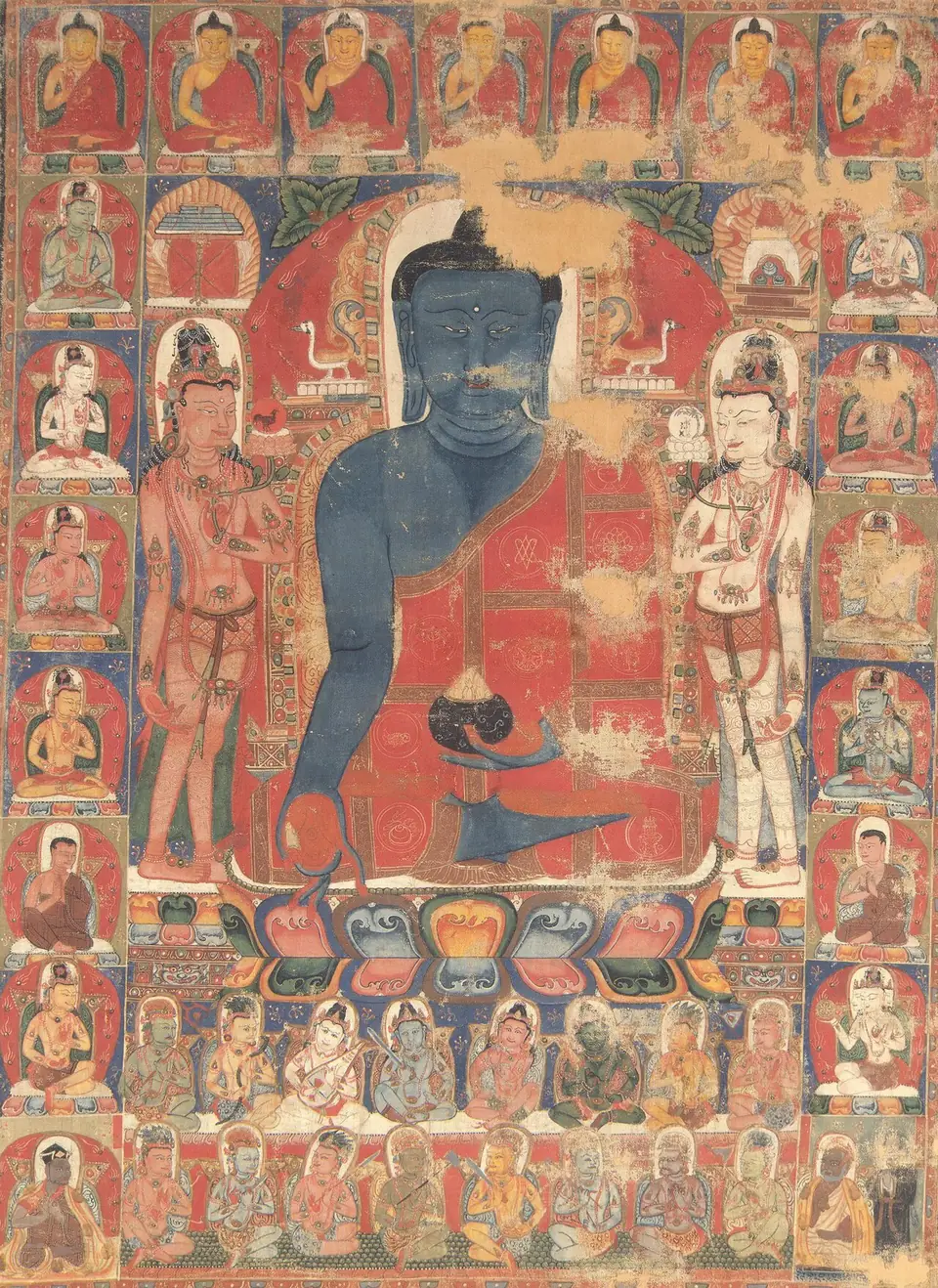
The Medicine Buddha, Bhaiṣajyaguru in Sanskrit, belongs to Mahāyāna Buddhism. His main text, the Medicine Buddha Sūtra, was known in India: Sanskrit fragments were found at Gilgit, in present-day Pakistan. It was later translated several times into Chinese, notably by the monk Xuanzang in 650 and by Yijing in the early 8th century.
How to recognise him
- A deep blue body, compared in the sūtra to lapis lazuli (vaiḍūrya).
- A seated meditation posture, legs crossed.
- In the left hand, resting in the lap, a bowl or jar.
- In the right hand, turned downwards in the gesture of giving, often a branch of myrobalan (arura), a fruit common in Asian pharmacopoeias.
Across traditions
In Tibet, Sangye Menla is often painted with seven other Medicine Buddhas, forming the group of the “eight Medicine Buddhas”. In China, Yaoshi Fo is often placed in the main hall of temples, beside Śākyamuni and Amitābha. In Japan, Yakushi Nyorai usually holds a small medicine jar in his left hand and raises his right hand. He is often flanked by two bodhisattvas, Nikkō (sunlight) and Gakkō (moonlight), and guarded by twelve heavenly generals.
Going further
The statues and thangkas in the catalogue show these differences well. The sūtra and its commentaries are in the books section.
Read the articleBhaiṣajyaguru, Menla, Yaoshi, Yakushi: the names by country