Hōryū-ji: the Yakushi inscription that tells of a vow made in 586
A sick emperor, a promise, a sister and a nephew who fulfil it: the inscription on the halo of the Hōryū-ji Yakushi is one of Japan’s best known, and one of its most debated.
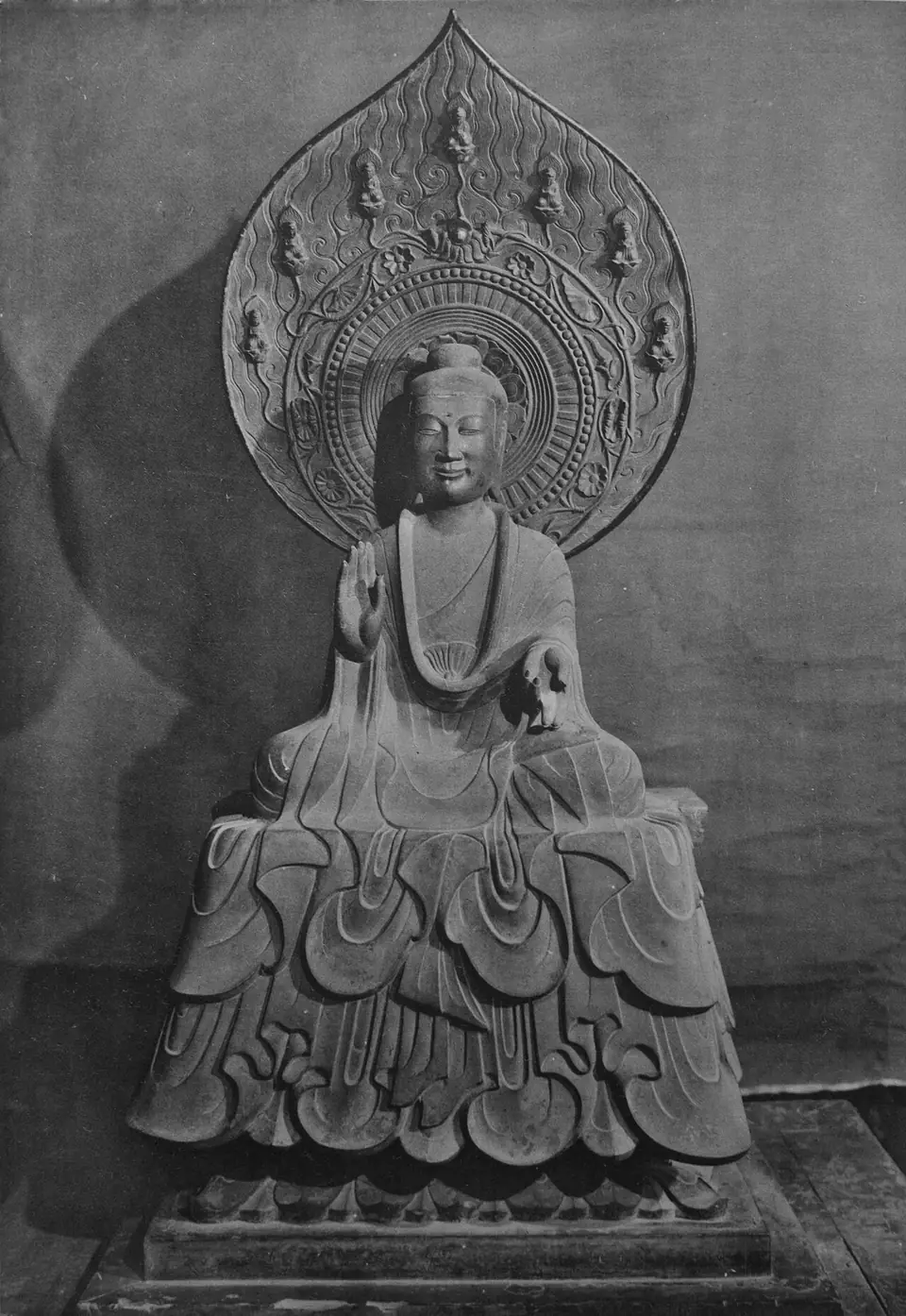
Hōryū-ji, near Nara, is often called one of the oldest wooden complexes in the world. In the main hall (Kondō), a statue of Yakushi Nyorai bears an inscription of a few dozen characters on the back of its halo. It tells a simple story.
What the inscription says
It explains that Emperor Yōmei, who fell ill in 586, vowed to build a temple and make a statue of Yakushi. He died soon after. His sister, Empress Suiko, and Prince Shōtoku, his nephew, completed the work: the text dates the completion to the fifteenth year of Suiko, which is 607 in the traditional calendar. That is why the temple tradition, and most guidebooks, give 607.
What historians say
The statue and its inscription raise two separate questions.
- Is the vow historical? Many scholars accept it, because a ruler promising a temple for his recovery fits other accounts of the period.
- Does the present statue date from 607? Many specialists doubt it. Compared with the temple’s Shaka triad, dated 623 by its own inscription, the casting technique and style of the Yakushi look somewhat later; the inscription may also have been copied or reworked later. A date toward the end of the seventh century is often proposed.
Why it matters
Together with Tenmu’s vow at Yakushi-ji, this inscription is one of the earliest testimonies to the Yakushi cult in Japan. It also shows how the cult arrived: through the court, at a moment of family fragility, before spreading across the country (see Yakushi-ji).
Seeing the image
An early photograph of the Kondō Yakushi is reproduced on this site. The Saien-dō of the same complex houses another Yakushi, from the eighth century, also reproduced here.
Uncertainties
The date 607 is conventional. The debates concern the age of the statue and of the halo text, not the existence of the cult at that time.
Sources
Hōryū-ji, official notices; Nara Prefecture, “About Horyu-ji Temple”; Dorothy C. Wong (ed.), Hōryūji Reconsidered (Cambridge Scholars, 2008); Japanese multilingual heritage text database (MLIT).
Read the articleGilgit, 1931: the day the Sanskrit sūtra turned up