Khara-Khoto: a blue Buddha from the desert, kept in Saint Petersburg
An abandoned Tangut city in the sands of Inner Mongolia, a Russian explorer in 1908, and a painting of the Medicine Buddha that has hardly been touched since.
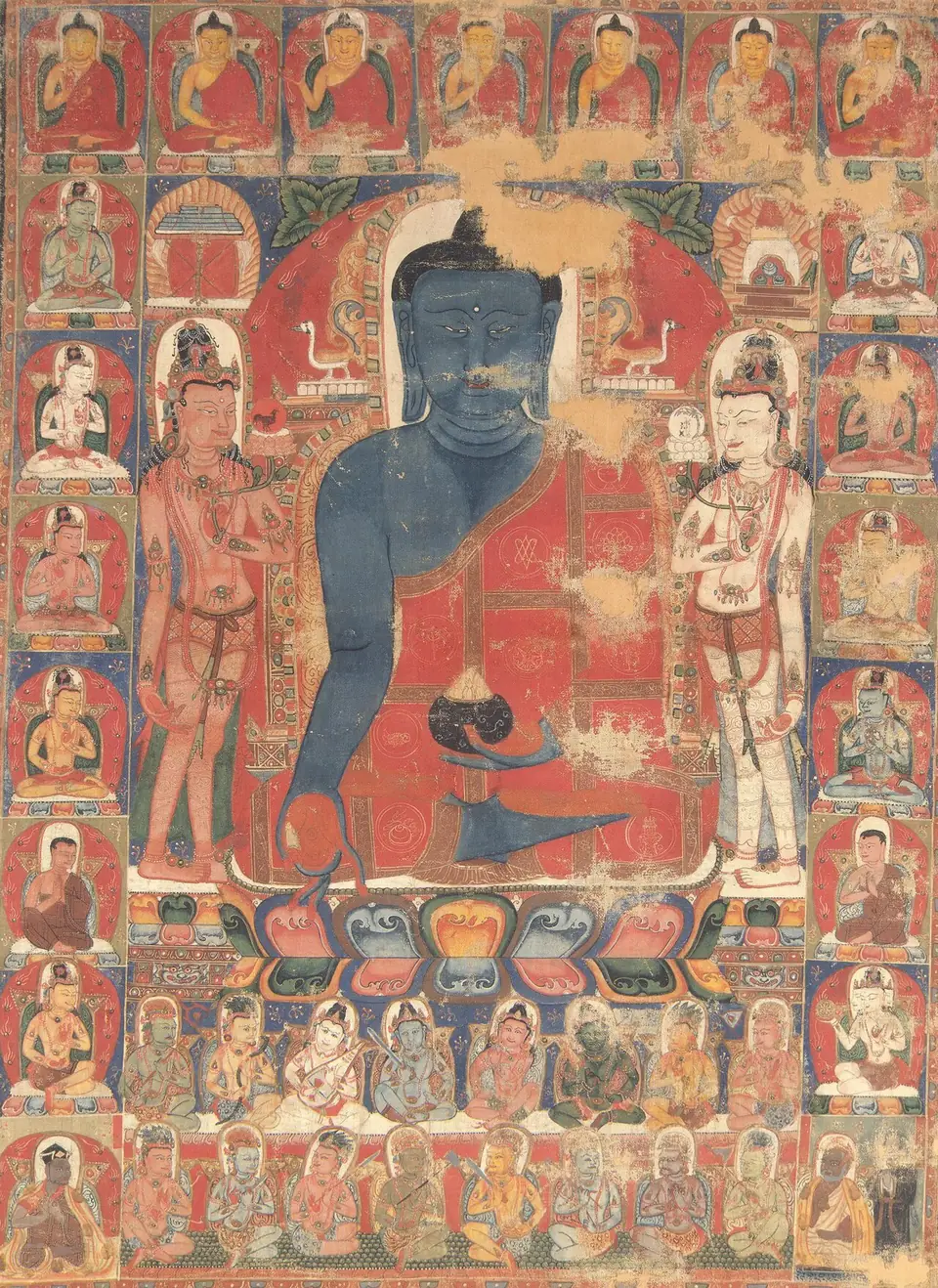
On the Silk Road, at the edge of the Gobi, stood a fortified city: Khara-Khoto, “the Black City” in Mongolian. It belonged to the Tangut empire (Xixia), a Buddhist kingdom of the eleventh to thirteenth centuries, and was gradually abandoned. In 1908–1909 the Russian explorer Pyotr Kozlov found a stūpa there filled with texts and paintings. Much of what he brought back is now in the State Hermitage Museum in Saint Petersburg.
A painting of the Medicine Buddha
The Hermitage holds several Buddhist paintings from Khara-Khoto dated to the twelfth to thirteenth centuries. One of them shows the Medicine Buddha, painted on cloth in a style that blends Chinese painting and Tibetan tradition, two worlds that met among the Tanguts. Specialists describe it as a rare medieval painting of Chinese inspiration in the Tibetan tradition; it is one of three Khara-Khoto icons on this subject. A copyright-free image is used on this site.
A kingdom between two worlds
- The Tanguts spoke a Tibeto-Burman language and had their own script.
- Their Buddhism drew on Tibet, China and Central Asia.
- Their kingdom was conquered by Genghis Khan’s Mongols in 1227, but the city of Khara-Khoto was not abandoned until the fourteenth century.
Why it is precious
This painting is a rare witness to the Medicine Buddha cult on the medieval Silk Road, between the older paintings of Dunhuang and the later great Tibetan series.
A restoration under way
The Hermitage has launched an appeal to support the restoration of this painting, which has not yet been restored.
Uncertainties
The exact date is given as a range (twelfth–thirteenth century). Historians discuss the respective shares of Chinese and Tibetan influence.
Sources
State Hermitage Museum, restoration project “Bhaisajyaguru” (inventory XX-2332 / XX-2333); scholarly papers on the Khara-Khoto collection (Wang, “Seeking the Pure Land in Tangut Art”, Brill, 2022); Journal of Inner Asian Art and Archaeology, “Imagined Pure-Lands of Bhaisajyaguru by Chinese and Tanguts”.
Read the articleThe Four Tantras: when the Medicine Buddha teaches in the city of Tanaduk