The Four Tantras: when the Medicine Buddha teaches in the city of Tanaduk
A founding book of Tibetan medicine, a city in the sky, a manuscript hidden in a pillar: the legend and the history of how the Four Tantras came to be.
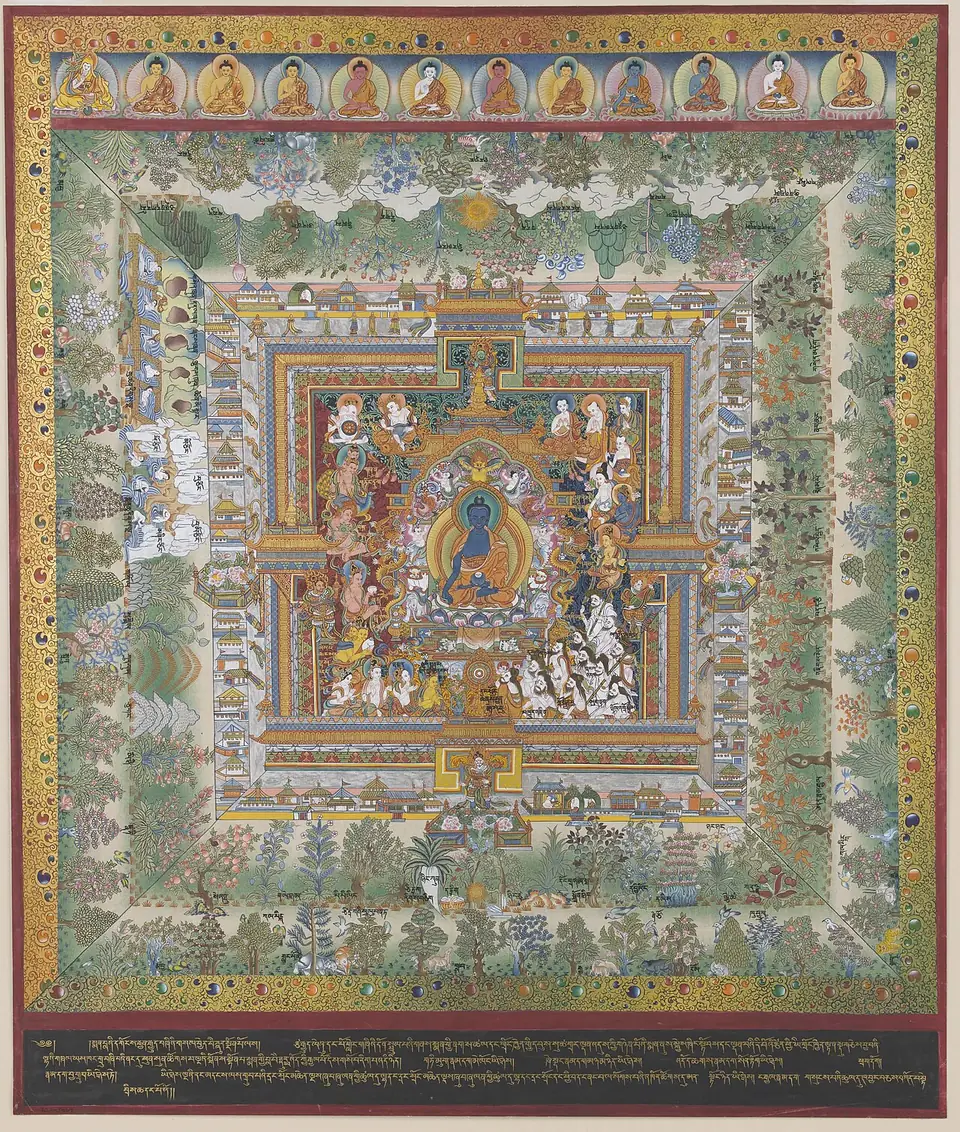
In Tibet, traditional medicine (sowa rigpa, or “sorig”) rests on one central text: the Gyushi, the Four Tantras. Its tradition of origin is unlike any other manual: it begins with a teaching by the Medicine Buddha.
The legend
According to Tibetan tradition, the Medicine Buddha teaches the Tantras in a marvellous city called Tanaduk (Sudarśana in Sanskrit), at the centre of a palace made of precious stones, described in the texts as surrounded by mountains rich in medicinal plants. There two sage figures appear: one teaches, the other asks the questions. Four assemblies listen: gods, sages, Buddhists and non-Buddhists. Medical knowledge is thus presented as a Buddhist teaching open to all.
From the sky to Tibet
Still according to tradition, the text is passed on by Indian sages, translated in Tibet in the time of King Trisong Detsen (eighth century), then hidden in a pillar of Samyé temple to preserve it. It is found again in 1038 by Drapa Ngonshe, a “treasure revealer” (tertön). A century later Yuthok Yonten Gonpo the Younger (1126–1202) receives the transmission, revises it, teaches it and is regarded as its chief compiler.
What historians say
Modern scholars are more nuanced. Many think the Four Tantras were compiled in Tibet in the twelfth century from Indian, Tibetan and perhaps Chinese sources. Yuthok and his students played a decisive part. The story of the manuscript hidden at Samyé belongs to the tradition of faith, not to documentary history. The two levels do not exclude each other: they tell how a community understands the origin of its knowledge.
The structure of the book
The Four Tantras have 156 chapters in four parts:
- the Root Tantra, 6 chapters;
- the Explanatory Tantra, 31 chapters;
- the Oral Instruction Tantra, 92 chapters;
- the Subsequent Tantra, 25 chapters.
The Root Tantra is presented in the form of a tree: three roots, nine trunks, forty-seven branches and two hundred and twenty-four leaves, a memory plan for students.
A text learned by heart
For centuries Tibetan students learned the Four Tantras by heart. The text is presented here as cultural heritage and history of ideas: this site gives no medical advice.
Going further
Desi Sangye Gyatso’s famous commentary is presented in the article on the Blue Beryl. Sorig vocabulary is in the sorig lexicon.
Uncertainties
The transmission dates (eighth century) and the Samyé episode belong to tradition; composition in the twelfth century is the most common hypothesis in history, but it is still debated.
Sources
Tibetan Buddhist Encyclopedia, “Drapa Ngonshe”; Tsadra Foundation, Khyentse Lineage (entries “Yuthok Yonten Gonpo” and “Drapa Ngonshe”); Library of Congress, authority record Yuthok Yonten Gonpo (1126–1202); Stanford History of Science, “Each of us a Healer: Medicine Buddha and the Karma of Healing”.
Read the articleThe Blue Beryl: the regent who had medicine painted