The twelve generals: the army that guards the Medicine Buddha
Twelve celestial commanders, each leading seven thousand spirits: who are they, and why were they linked to the twelve zodiac animals?
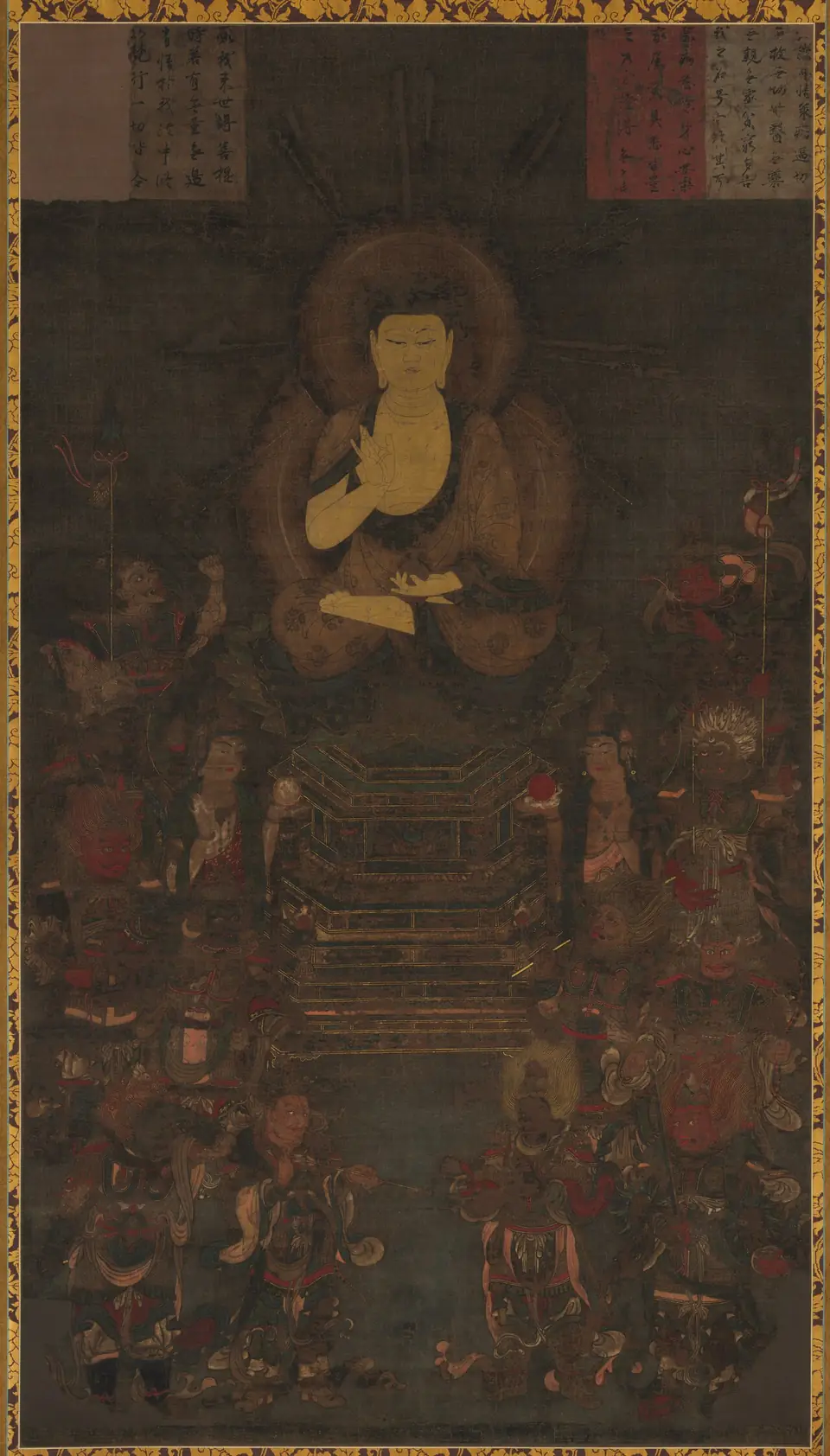
In the Medicine Buddha Sūtra, not everything happens between the Buddha and his disciples. Near the end, twelve great yaksha chiefs rise together. Yakshas are powerful spirits of Indian tradition, sometimes fearsome, whom Buddhism often turned into protectors. Here they make a vow: to watch over anyone who bears the name of the Medicine Buddha and to guard them from misfortune.
What the text says
According to the sūtra, each of the twelve generals commands seven thousand yakshas, for an army of eighty-four thousand. The text names the twelve chiefs; their names were transcribed into Chinese, then read in Japanese, and the Sanskrit reconstructions vary from one author to another. That is why several spellings of each name circulate.
The Japanese names
- Kubira, Basara (Bazara), Meikira, Anchira (Antera), Anira, Sandera (Sanchira)
- Indara, Haira, Makora, Shindara, Shōtora (Shotora), Bikara
Basara, the fiercest of the twelve, with upright hair and a raised weapon, is the one most often reproduced today.
The twelve animals
In several traditions the twelve generals were matched with the twelve signs of the zodiac, and so with the twelve hours of the day, the twelve months and the twelve directions. Each general becomes the guardian of one sign, often shown by a small animal on his headdress. The most common matching starts with Kubira and the rat, but it varies from temple to temple and from period to period; it is not found in the sūtra itself. This is why small general figures are sometimes sold as “protector of your birth year”.
How to recognise them
- They wear armour, carry weapons (sword, spear, club, bow) and have a stern gaze.
- They are almost always shown as a group of twelve around Yakushi, in a circle in a temple or in two rows in a painting.
- In Chinese-speaking traditions they are called the “twelve great yaksha generals” (十二藥叉大將).
Where to see them
The oldest surviving set in Japan is in Nara, at Shin-Yakushi-ji. A Japanese Kamakura-period painting in Cleveland shows them around the Buddha; it is reproduced on this site. For the story they belong to, read the sūtra.
Uncertainties
The Sanskrit names of the twelve generals are not fixed in a single way; the zodiac matching is a tradition that varies by place and period.
Sources
Medicine Master Sūtra, trans. Xuanzang (T. 450); Japan’s Agency for Cultural Affairs records; Shin-Yakushi-ji official site (page on the twelve generals); Cleveland Museum of Art online collection.
Read the articleShin-Yakushi-ji: eleven clay generals standing guard for more than a thousand years