The Medicine Buddha Sūtra: the story of a travelling text
A birch-bark manuscript, a pilgrim monk, a visiting translator: how a sūtra from India became one of the most read texts of East Asia.
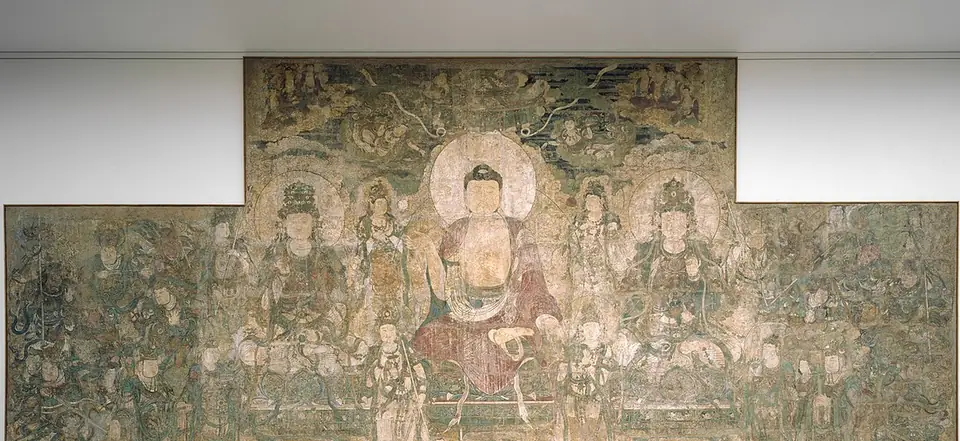
The text opens at Vaiśālī, a city of ancient India. The Buddha is staying there with a great assembly of monks, bodhisattvas, kings and beings from every world. The bodhisattva Mañjuśrī rises and asks him to speak of the qualities of another Buddha, far to the east, whose name will be a help in difficulty for beings of future generations. The Buddha agrees: this is the beginning of the Medicine Buddha Sūtra (Bhaiṣajyaguruvaiḍūryaprabharāja-sūtra).
What the sūtra tells
The text is short and follows a simple plan. First, the description of the Buddha of a distant land and of his twelve great vows. Then the description of his pure land, his bodhisattvas and his benefits. Finally, practical advice: how to honour him, how to recite his name, which offerings to prepare. Near the end, a bodhisattva named Deliverer (Jiutuo, in Xuanzang’s version) asks Ānanda about the “nine untimely deaths” and what can be done to avoid them. The rites described (lamps lit, banners hung, offerings) are presented as ways of awakening kindness and wisdom, and of honouring the memory of the dead.
A manuscript found near Gilgit
In 1931, local people near Gilgit, in the Karakoram, came by chance upon a set of birch-bark manuscripts in a ruined stūpa. They are in Sanskrit, in a script called “Gilgit-Bamiyan”. Among them is the Medicine Buddha Sūtra. It was edited in 1939 by Nalinaksha Dutt in the series Gilgit Manuscripts, and it is the oldest known Sanskrit version. It is a lovely surprise: the text, which was known only through its translations, did exist in India or on its borders in this form.
The Chinese translations
In China the sūtra was translated several times. An early version, attributed to Śrīmitra, dates from the 4th century. Dharmagupta gave another in 615, under the Sui. The most famous is Xuanzang’s, in 650, by the monk who had crossed Central Asia and India to bring back texts; it is the basis of most recitations in China, Korea, Japan and Vietnam. In 707 Yijing, another travelling monk who returned from India by sea, offered a longer version describing not one but seven Medicine Buddhas. These translations are kept in the Chinese canon (Taishō 449 to 451).
The text in Tibet
The text is also kept in the Tibetan Kangyur, where both the “single Buddha” version and the “seven Tathāgatas” version exist. The eight Medicine Buddhas, whose images decorate so many monasteries, come from this tradition.
Why it was so successful
In societies where illness, poverty and war were close to everyone, a Buddha whose vows promise help, food, clothing and justice spoke to all. In Japan, it was a prayer for an emperor’s wife that gave birth to Yakushi-ji in 680; the story is in the article on Yakushi-ji.
Reading the sūtra today
Translations exist in French and English, with commentaries; you will find them in the books section. A cursory reading takes less than an hour. The sūtra reads like a prayer, not a medical treatise: see the article on spiritual health.
Sources
Nalinaksha Dutt, Gilgit Manuscripts, vol. I (Srinagar, 1939); Raoul Birnbaum, The Healing Buddha (1979); Taishō Tripiṭaka 449–451. The dates of the oldest translations are attributions by tradition.
Read the articleThe twelve vows of the Medicine Buddha, one by one