An anthropology of healing rituals
Life-prolonging lamps in medieval China, court rites in Japan, consecration of Tibetan medicines: what historians and anthropologists describe.
What the sources say
Established
The sūtra (Xuanzang’s version) describes a rite for a sick person: lighting forty-nine lamps, hanging a banner, reciting the text for forty-nine days and releasing living beings.
Sources 1
Established
This “life-prolonging” lamp rite was practised in China in the 5th and 6th centuries; the historian Zhiru Shi studies it as a central form of ritual healing in the Bhaiṣajyaguru cult.
Sources 2
Established
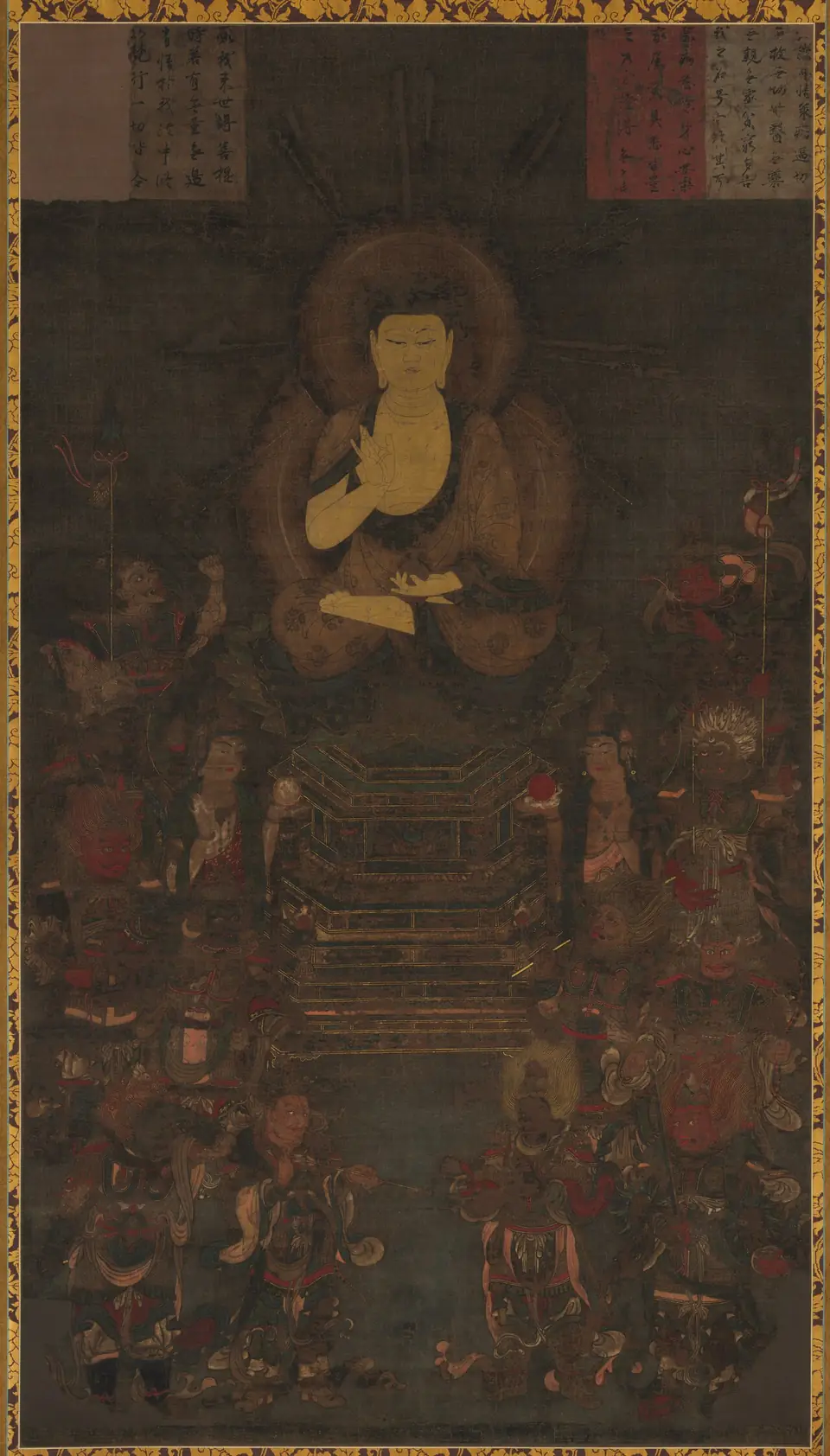
In Japan, the Yakushi cult is attested from at least the late 7th century, mainly at court and among the nobility: temples and statues were vowed for the recovery of rulers, as at Yakushi-ji.
Established
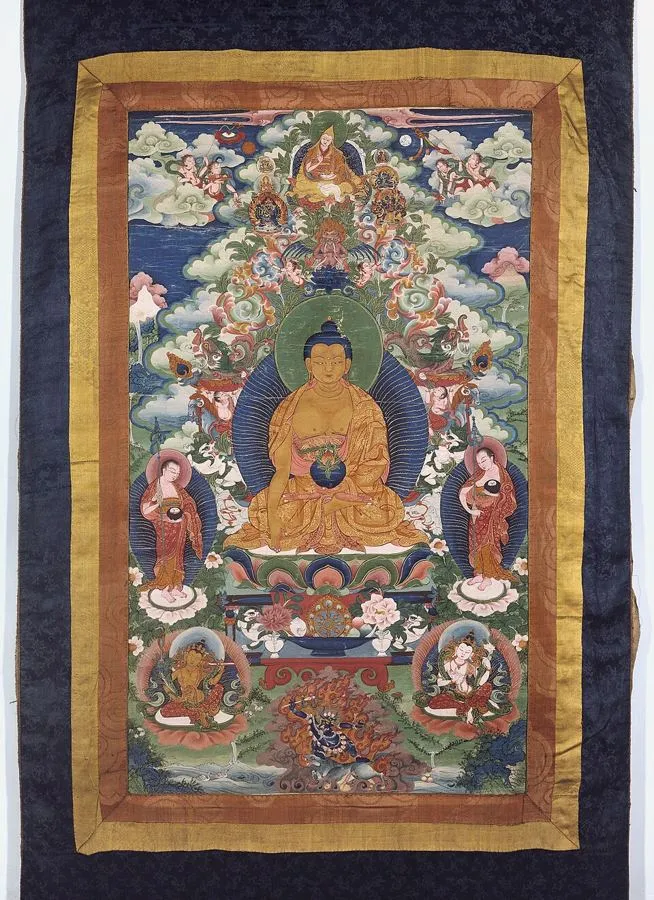
In Tibetan medicine, rites of “accomplishing medicine” (sman sgrub) consecrate preparations; anthropologists have studied their Buddhist and Bon forms.
Belief
For many practitioners, reciting the Medicine Buddha mantra and consecrating the “precious pills” increases their efficacy; Barbara Gerke describes these practices without presenting them as proven.
Sources 6
Established
The anthropologist Sienna Craig shows that, for its practitioners, the “efficacy” of Tibetan medicine combines material, social and ritual dimensions, which makes comparison with clinical trials complex.
Sources 7
How to read the badges
Established Debated Hypothesis Belief
Established: attested in the sources and accepted by specialists. Debated: specialists disagree. Hypothesis: proposed, not demonstrated. Belief: what the religious tradition says, with no historical claim.
Sources
- CBETA, Taishō T450, 藥師琉璃光如來本願功德經 (Xuanzang, 650). cbetaonline.dila.edu.tw
- Zhiru Shi, “Lighting Lamps to Prolong Life: Ritual Healing and the Bhaiṣajyaguru Cult in Fifth- and Sixth-Century China”, in C. P. Salguero & A. Macomber (eds.), Buddhist Healing in Medieval China and Japan, University of Hawaiʻi Press, 2020. uhpress.hawaii.edu
- JAANUS (Japanese Architecture and Art Net Users System), entry “Yakushi”. www.aisf.or.jp
- Yakushi-ji (official site), “Yakushiji Digital Picture Scroll”. www.yakushiji.or.jp
- Oxford University Research Archive, “The Bon sman sgrub ritual”. ora.ox.ac.uk
- Barbara Gerke, “The Administration of Tibetan Precious Pills: Efficacy in Historical and Ritual Contexts”, Asian Medicine (open access, PubMed Central). pmc.ncbi.nlm.nih.gov
- Sienna R. Craig, Healing Elements: Efficacy and the Social Ecologies of Tibetan Medicine, University of California Press, 2012. www.ucpress.edu
Links checked on 15 October 2026.