Archaeology and art history: Dunhuang, Nara, iconography
Mogao Cave 220 (642), the Cave 17 paintings, the Yakushi-ji triad: dated works and dating debates.
What the sources say
Established
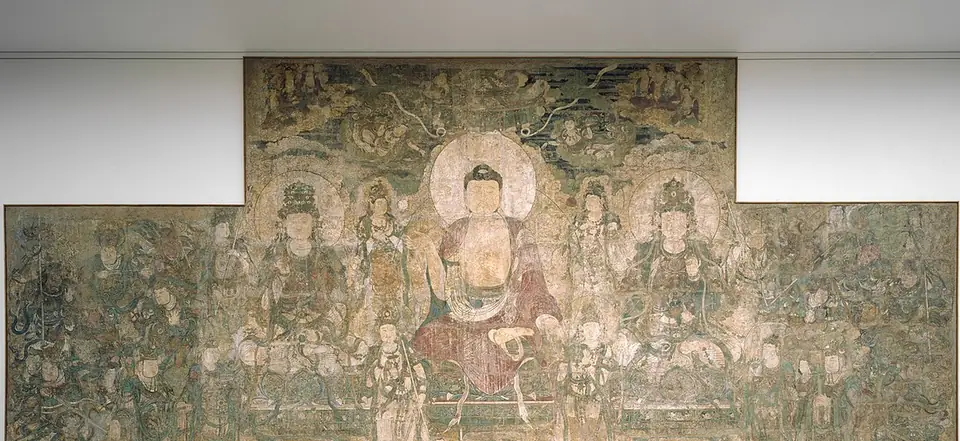
In Mogao Cave 220 at Dunhuang, the north wall carries a large composition of the seven standing Medicine Buddhas, with bodhisattvas, generals, lamps and dancers. Ink inscriptions of the 16th year of Zhenguan (642) date the painting; the cave was sponsored by the Zhai family.
Established
In Mogao Cave 17 (the sealed “library cave”), Aurel Stein found silk paintings of the Medicine Buddha that are now in the British Museum, including a large “Paradise of Bhaiṣajyaguru” (1919,0101,0.32) and an image of the Buddha holding a bowl (1919,0101,0.27, late 9th–early 10th century).
Debated
The large Paradise of Bhaiṣajyaguru carries Chinese and Tibetan inscriptions dating it to 836; the International Dunhuang Programme notes that it may have been produced later.
Established
Emperor Tenmu vowed to build Yakushi-ji in 680 for the empress’s recovery; the temple was moved from Fujiwara-kyō to Nara (Heijō-kyō) around 718. It is part of the “Historic Monuments of Ancient Nara” (UNESCO).
Debated
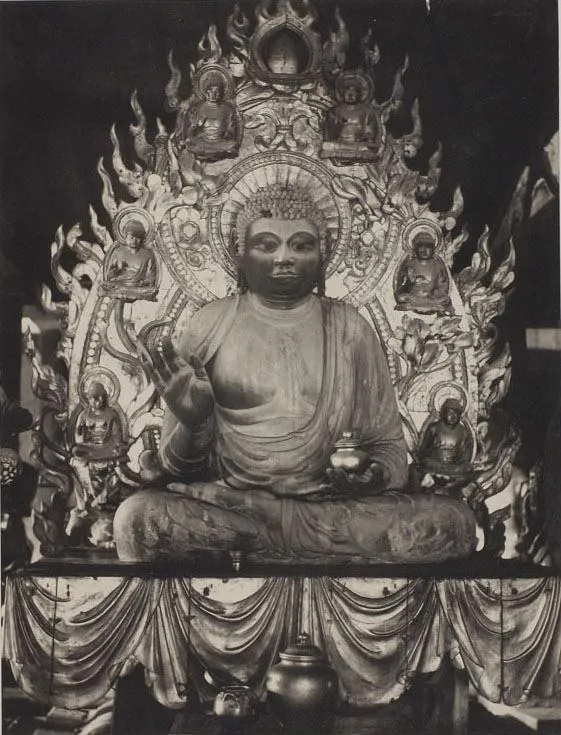
Was the gilt-bronze triad of the Yakushi-ji Golden Hall cast at Fujiwara-kyō in the late 7th century and carried to Nara, or recast in Nara after 718? It is one of the great debates of Japanese art history; JAANUS dates it “late 7th century or 718”.
Established
In Japan, Yakushi’s characteristic attribute is the medicine jar in the left hand; it is not described in the sūtras, and early Japanese images can hardly be told apart from those of Shaka (Śākyamuni).
Sources 9
Established
In Tibetan and Himalayan art he is usually blue, seated, with a bowl in the left hand and a myrobalan branch in the right.
Sources 11
How to read the badges
Established Debated Hypothesis Belief
Established: attested in the sources and accepted by specialists. Debated: specialists disagree. Hypothesis: proposed, not demonstrated. Belief: what the religious tradition says, with no historical claim.
Sources
- Dunhuang Academy (敦煌研究院), 莫高窟第220窟. www.dha.ac.cn
- University of Washington Dunhuang Project, “Mogao Cave 220 Overview”. www.dunhuang.ds.lib.uw.edu
- UNESCO World Heritage Centre, “Mogao Caves”. whc.unesco.org
- British Museum, 1919,0101,0.32, Paradise of Bhaiṣajyaguru, ink and colour on silk, Cave 17, Dunhuang. www.britishmuseum.org
- British Museum, 1919,0101,0.27, painting of Bhaiṣajyaguru holding a bowl, late 9th–early 10th century. www.britishmuseum.org
- International Dunhuang Programme (British Library), “Shaping the Stein collection’s Dunhuang corpus (2)”. idp.bl.uk
- Yakushi-ji (official site), “Yakushiji Digital Picture Scroll”. www.yakushiji.or.jp
- UNESCO World Heritage Centre, “Historic Monuments of Ancient Nara”. whc.unesco.org
- JAANUS (Japanese Architecture and Art Net Users System), entry “Yakushi”. www.aisf.or.jp
- CiNii Research, “On the creation and transfer of the Yakushi Triad at Yakushiji”. cir.nii.ac.jp
- Raoul Birnbaum, The Healing Buddha, Shambhala, 1979 (rev. 1989). (book)
Links checked on 15 October 2026.