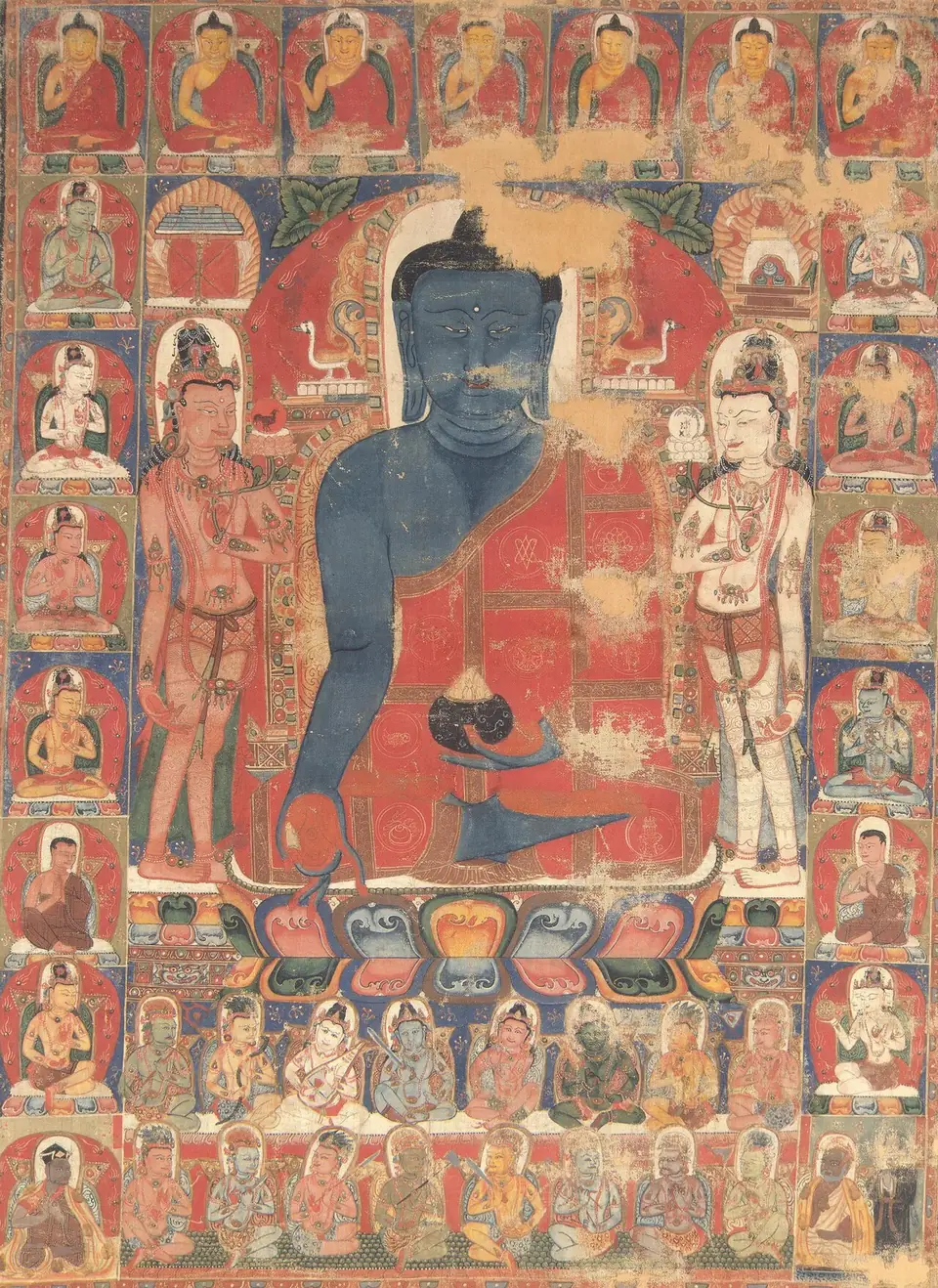
Medicine Buddha timeline: 44 dates from the sutra to today
Forty-four dates, from the first translations of the sutra to the museums of today, each explained in a few sentences with a source.
- IV
The oldest Chinese version is attributed to Śrīmitra (4th century). It forms book 12 of the Consecration Sutra (Taishō T1331), a collection of protective texts.
In the glossary: The sutra · Kangyur and Taishō (the canons)
- V–VI
At Gilgit (in present-day Pakistan), Sanskrit manuscripts are copied, among them the sutra of the Medicine Buddha. They are among the oldest Buddhist manuscripts known.
In the glossary: The sutra
Where to see it: National Archives of India
- 607
Founding of Hōryū-ji by Prince Shōtoku. An inscription on the bronze Yakushi of its Golden Hall gives the year 607; historians debate whether it is that old.
In the glossary: Yakushi Nyorai (Japanese)
Where to see it: 法隆寺 Hōryū-ji
- 616
Dharmagupta translates the sutra into Chinese (Taishō T449). It is the first of the three classic translations.
In the glossary: The sutra
- 618–649
At Dunhuang, Cave 322 receives a painting of the Medicine Buddha, one of the oldest kept in place. Lapis uses it on the Discover page.
In the glossary: The Pure Land of the East
Where to see it: 莫高窟 Mogao Caves
- 642
In Cave 220 at Dunhuang, a large mural of the Pure Land of the East carries a date equivalent to 642. It shows palaces, a lake and an orchestra.
In the glossary: The Pure Land of the East
Where to see it: 莫高窟 Mogao Caves
- 650
The monk Xuanzang, back from India, makes the most widely read translation (Taishō T450). It is the version most often recited in East Asia.
In the glossary: The sutra
- 680
Emperor Tenmu vows to build a temple for the recovery of the sick empress: this is the beginning of Yakushi-ji. The temple takes shape around 688.
In the glossary: Yakushi Nyorai (Japanese)
Where to see it: 薬師寺 Yakushi-ji
- 707
Yijing translates a longer version describing seven buddhas (Taishō T451). It is the source of the Seven Medicine Buddhas.
In the glossary: The Seven Medicine Buddhas
- 718
Yakushi-ji is moved to the new capital, Heijō-kyō (Nara). The bronze triad of its main hall is admired as a masterpiece of the period.
In the glossary: Sunlight and Moonlight
Where to see it: 薬師寺 Yakushi-ji
- 747
Empress Kōmyō founds Shin-Yakushi-ji in Nara, wishing for the recovery of Emperor Shōmu, who has an eye illness.
In the glossary: The Twelve Generals
Where to see it: 新薬師寺 Shin-Yakushi-ji
- VIII
The clay statues of the Twelve Generals of Shin-Yakushi-ji are made; eleven of them are original and National Treasures.
In the glossary: The Twelve Generals
Where to see it: 新薬師寺 Shin-Yakushi-ji
- VIII–IX
In Korea, under Unified Silla, the gilt-bronze standing Medicine Buddha of Baengnyulsa is cast. It is now at the Gyeongju National Museum.
In the glossary: Yaksa yeorae (Korean)
Where to see it: 국립경주박물관 Gyeongju National Museum
- IX
On Mount Palgong, near Daegu, the stone seated buddha of Gatbawi is carved. It is now called a Medicine Buddha, though older sources named it differently.
In the glossary: Yaksa yeorae (Korean)
Where to see it: 갓바위 Gatbawi
- IX
The sutra is translated into Tibetan by Jinamitra, Dānaśīla and Yeshé Dé; it later enters the Kangyur (Toh 504).
In the glossary: Kangyur and Taishō (the canons)
- IX
In Kyoto, the standing wooden Yakushi of Jingo-ji is carved (early Heian, National Treasure). It is still the main image of the temple.
In the glossary: Yakushi Nyorai (Japanese)
Where to see it: 神護寺 Jingo-ji
- IX
At Shōjō-ji in Fukushima, a Yakushi triad is carved; it is now a National Treasure, one of the major early works of northern Japan.
In the glossary: Yakushi Nyorai (Japanese)
Where to see it: 勝常寺 Shōjō-ji
- 907
At Daigo-ji, at Emperor Daigo’s request, a Yakushi hall is built for a Yakushi triad.
In the glossary: Hibutsu (hidden buddha)
Where to see it: 醍醐寺 Daigo-ji
- 1051
Hino Sukenari has a Yakushi made at Hōkai-ji in Kyoto and builds a hall for it; the temple is known as Hino Yakushi.
In the glossary: Yakushi Nyorai (Japanese)
Where to see it: 法界寺 Hōkai-ji (Hino Yakushi)
- 1103
The sculptors Ensei and Chōen carve the sandalwood Yakushi of Ninna-ji. Its halo shows the Seven Medicine Buddhas and the bodhisattvas Sunlight and Moonlight.
In the glossary: The Seven Medicine Buddhas · Halo and mandorla
Where to see it: 仁和寺 Ninna-ji
- 1107
A record says the main Yakushi of Jōruri-ji is moved to a “western hall”; the temple’s name comes from the Pure Land of the Medicine Buddha.
In the glossary: The Pure Land of the East
Where to see it: 浄瑠璃寺 Jōruri-ji
- XII
Yuthok Yönten Gönpo the Younger edits the Four Tantras, the treatise of Tibetan medicine framed as a teaching of the Medicine Buddha.
In the glossary: The Four Tantras
- XII–XIII
At Khara-Khoto, a city of the Tangut state, thangkas of the Medicine Buddha are painted. Found in 1909, they are now at the Hermitage.
In the glossary: Sangye Menla (Tibetan) · Thangka
Where to see it: Государственный Эрмитаж · State Hermitage Museum
- 1319
In Shanxi, a great mural of the Medicine Buddha is painted at Guangsheng Temple (about 1319). It has been at the Met in New York since the 20th century.
In the glossary: Yàoshī fó (Chinese)
Where to see it: 广胜寺 Guangsheng Temple · The Metropolitan Museum of Art
The Met, Buddha of Medicine Bhaishajyaguru (Yaoshi fo), 65.29.2
- 1528
Fire destroys the main hall of Yakushi-ji. The bronze triad survives; the hall will only be rebuilt in 1976.
In the glossary: Yakushi Nyorai (Japanese)
Where to see it: 薬師寺 Yakushi-ji
- 1603
At Tō-ji in Kyoto, the Golden Hall receives a new seated Yakushi, with the twelve generals on its pedestal.
In the glossary: The Twelve Generals
Where to see it: 東寺 Tō-ji
- 1687–1703
Under regent Desi Sangye Gyatso, the paintings of the Blue Beryl are made in Lhasa; the first shows the Medicine Buddha.
In the glossary: The Blue Beryl
- 1696
Desi Sangye Gyatso founds a medical college on Chakpori hill in Lhasa.
In the glossary: The Four Tantras
Where to see it: ལྕགས་པོ་རི Chakpori
- 1725
At Kumbum monastery (Qinghai), a medical college opens, devoted to Tibetan medicine.
In the glossary: The Four Tantras
Where to see it: 塔尔寺 Kumbum Monastery
- 1816
At Aginsky Datsan (Transbaikalia), a temple devoted to Manla, the Medicine Buddha, is built.
In the glossary: Otoch Manla (Mongolian, Buryat)
Where to see it: Агинский дацан · Aginsky Datsan
- 1884
Aginsky Datsan opens a medical faculty; the Buryat datsans become known for their schools.
In the glossary: Otoch Manla (Mongolian, Buryat)
Where to see it: Агинский дацан · Aginsky Datsan
- 1900
At Dunhuang, the “library cave” is discovered: tens of thousands of manuscripts and paintings, some of the Medicine Buddha, later scattered between London, Paris and elsewhere.
In the glossary: The Pure Land of the East
Where to see it: 莫高窟 Mogao Caves
- 1916
The 13th Dalai Lama founds the Men-Tsee-Khang in Lhasa, an institute of medicine and astrology.
In the glossary: The Four Tantras
Where to see it: Men-Tsee-Khang
- 1924–1934
In Tokyo, the Taishō canon is published; volume 14 contains the translations of the sutra. It is still the reference edition.
In the glossary: Kangyur and Taishō (the canons)
- 1931
The Gilgit manuscripts are found; many are now at the National Archives of India in New Delhi.
In the glossary: The sutra
Where to see it: National Archives of India
- 1959
The Chakpori college in Lhasa is destroyed during the uprising.
Where to see it: ལྕགས་པོ་རི Chakpori
- 1961
The Men-Tsee-Khang is re-established in Dharamshala, India.
Where to see it: Men-Tsee-Khang
- 1962
The Baengnyulsa statue is designated a National Treasure of Korea.
In the glossary: Yaksa yeorae (Korean)
Where to see it: 국립경주박물관 Gyeongju National Museum
- 1976
The main hall of Yakushi-ji is rebuilt in the style of the period, to house the bronze triad.
In the glossary: Yakushi Nyorai (Japanese)
Where to see it: 薬師寺 Yakushi-ji
- 1987
The Mogao caves at Dunhuang are inscribed on the UNESCO World Heritage List.
In the glossary: The Pure Land of the East
Where to see it: 莫高窟 Mogao Caves
- 1989
Forty-nine temples in seven prefectures of western Japan form the Saigoku pilgrimage of the Medicine Buddha; Lapis places them on its map.
In the glossary: Yakushi Nyorai (Japanese)
- 1992
At Donghwasa, near Daegu, a large stone statue of the Medicine Buddha is made: the Tongil Yaksa Daebul.
In the glossary: Yaksa yeorae (Korean)
Where to see it: 동화사 Donghwasa
- 1998
Yakushi-ji is inscribed on the UNESCO list with the “Historic Monuments of Ancient Nara”.
In the glossary: Yakushi Nyorai (Japanese)
Where to see it: 薬師寺 Yakushi-ji
- 2024
The Rubin Museum in New York closes its building and continues online and through loans.
In the glossary: Maṇḍala
Where to see it: Rubin Museum of Art
The svastika, a sign of good fortune
The word comes from Sanskrit: su (good) and asti (to be). It means “well-being” and “good fortune”.
In India, for thousands of years, Hindus and Jains have drawn it on doors, altars and books to invite good luck.
For Jains, it is the emblem of the 7th Tīrthaṅkara, Supārśvanātha. Its four arms recall the four states of existence.
In Buddhism, it is one of the auspicious signs. On many statues, it is drawn on the Buddha’s chest.
In Tibet, the Bön religion calls it yungdrung: it stands for the eternal, what cannot be broken.
In China, Japan and Korea, it is written 卍 (manji in Japan). On Japanese maps, this sign marks a Buddhist temple.
Sources: Monier-Williams, svastika · Wikipedia, Jain symbols · Wikipedia, Physical characteristics of the Buddha · Wikipedia, Yungdrung · Wikipedia, Manji · Wikipedia, Japanese map symbols
Sources (29)
- Śrīmitra 帛尸梨蜜多羅, Taishō T21 n1331
- Wikipedia, Gilgit manuscripts
- Wikipedia, Hōryū-ji
- Dharmagupta 達摩笈多 (616), Taishō T14 n0449
- Wikipedia, Mogao Caves
- Xuanzang 玄奘 (650), Taishō T14 n0450
- Wikipedia, Yakushi-ji
- Yijing 義淨 (707), Taishō T14 n0451
- Wikipedia, Shin-Yakushi-ji
- Wikipedia, 경주 백률사 금동약사여래입상
- Wikipedia, 경산 팔공산 관봉 석조여래좌상
- 84000, The Detailed Account of the Previous Aspirations of the Blessed Bhaiṣajyaguruvaiḍūryaprabha (Toh 504)
- Wikipedia, 神護寺
- Wikipedia, 勝常寺
- Wikipedia, Daigo-ji
- Wikipedia, 法界寺
- Wikipedia, Ninna-ji
- Wikipedia, Jōruri-ji
- Wikipedia, Traditional Tibetan medicine
- Wikipedia, Khara-Khoto
- The Met, Buddha of Medicine Bhaishajyaguru (Yaoshi fo), 65.29.2
- Wikipedia, Tō-ji
- Wikipedia, Men-Tsee-Khang
- Wikipedia, Kumbum Monastery
- Wikipedia, Агинский дацан
- Wikipedia, Taishō Tripiṭaka
- Wikipedia, 西国薬師四十九霊場
- Wikipedia, 동화사
- Wikipedia, Rubin Museum of Himalayan Art
Texts by Lapis, checked on 17 October 2026. Historical and cultural content.