The Medicine Buddha on one timeline: a sourced chronology
Fifteen landmarks from the sixth century to today, with what is certain and what is not.
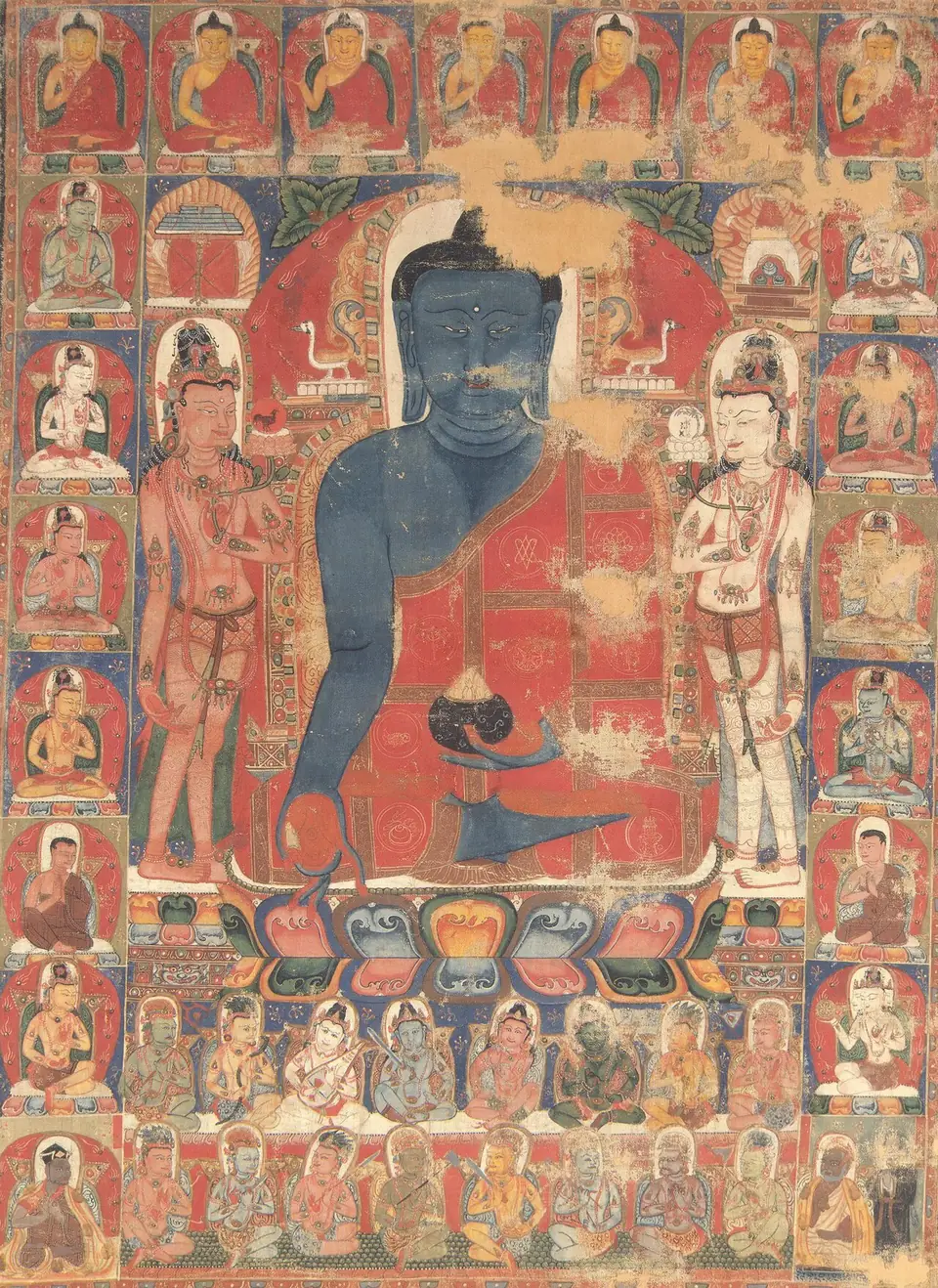
Here are the firmest landmarks in the history of the Medicine Buddha. Each points to an article on the site.
The beginnings
- Fourth century: first Chinese translation of the sūtra, attributed to Śrīmitra (old catalogues mention it; the text is not preserved as such).
- About the sixth to seventh century: the Gilgit Sanskrit manuscripts, the oldest surviving Indian version (see Gilgit).
- 615, 650, 707: Chinese translations by Dharmagupta, Xuanzang and Yijing (see the sūtra).
Japan
- 586 (vow) and 607 (conventional date): the Yakushi of Hōryū-ji (see Hōryū-ji).
- 680: Tenmu’s vow for the founding of Yakushi-ji (see Yakushi-ji).
- 729–749: the clay twelve generals of Shin-Yakushi-ji (see Shin-Yakushi-ji).
Korea and Southeast Asia
- 755: the Baengnyulsa statue according to tradition (see Korea).
- 1186: the Ta Prohm stele on the one hundred and two hospitals (see Angkor).
Central Asia and Tibet
- Twelfth–thirteenth century: the Khara-Khoto painting (see Khara-Khoto).
- 1038: rediscovery of the Four Tantras according to tradition; twelfth century: Yuthok’s work (see the Four Tantras).
- 1687–1703: the Blue Beryl and its paintings (see Desi Sangye Gyatso).
- 1696: founding of the Chakpori; 1916: Men-Tsee-Khang (see Chakpori).
Modern times
- 1908–1909: Kozlov at Khara-Khoto; 1931: the Gilgit manuscripts.
Uncertainties
Several dates are those of tradition (foundations, vows); the datings of manuscripts and statues are approximate.
Sources
See the sources of each linked article.
Read the articleThe story of the sūtra: Mañjuśrī, the Rescuer and the twelve generals