Angkor: the king who built one hundred and two hospitals under the gaze of the Medicine Buddha
In 1186 a stone stele records a network of royal hospitals across the Khmer empire, placed under the protection of Bhaiṣajyaguru.
In the twelfth century King Jayavarman VII (c. 1122–1218) made compassion a matter of state policy. His projects included a road, rest houses for travellers and, above all, a network of hospitals. The text that speaks of it is carved in Sanskrit on a large stele at Ta Prohm temple, dated 1186.
What the stele says
The Ta Prohm inscription (K. 273) states that the king founded one hundred and two ārogyaśālā, literally “houses of health”, across the kingdom. It details the annual provisions of rice, clothing, ritual objects and medicinal substances, and the staff assigned to each establishment. The inscription also names the tutelary deity of each house.
The Medicine Buddha as protector
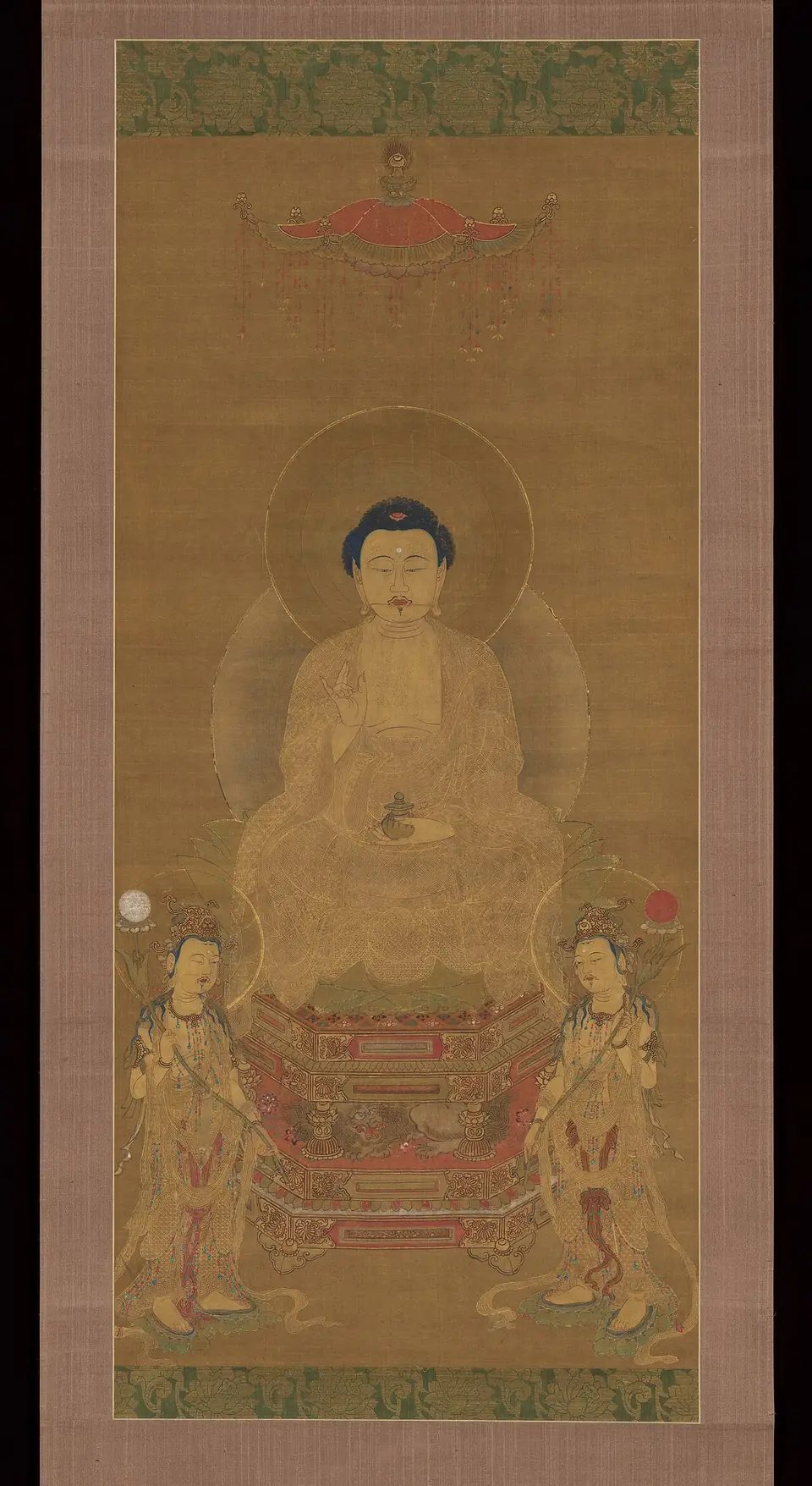
Each hospital has as its deity Bhaiṣajyaguru-vaiḍūrya-prabha, the Medicine Buddha, flanked by two bodhisattvas, Sūryavairocana and Candravairocana, who echo the sun and moon bodhisattvas of the Chinese and Japanese tradition. It is one of the earliest proofs of a state cult of the Medicine Buddha in Southeast Asia, and one of the few attestations of this triad in a precise text.
Beyond Angkor
Other steles confirm that the programme was applied outside the capital. The Say Fong stele, found in present-day Laos near Vientiane (K. 368), takes up the terms of the Ta Prohm inscription and gives a version for the regional hospital.
What can be said, and what cannot
- We know the king founded a network of hospitals and that a cult of the Medicine Buddha was attached to it.
- We know less about how the hospitals worked in practice: there is no patient register and no precise medical description.
- The remains of some buildings have been identified on the ground, but most have disappeared.
Going further
To place Angkor in the journey of the cult, read From India to Vietnam.
Uncertainties
The number one hundred and two is the stele’s; we do not know how many actually operated.
Sources
Ta Prohm inscription K. 273 (translated by George Cœdès, 1906); Say Fong inscription K. 368; Wikipedia, “Arogayasala”; Angkor Database, “Bhaisajyaguru and Tantric Medicine in Jayavarman VII Hospitals”.
Read the articleKorea: Yaksa Yeorae, a Buddha serving the kingdom of Silla